
Messages that go unanswered, calls that ring out, a prospect list that never moves: if you're looking for prospecting techniques that actually work, you're in the right place. 👽 We've gathered 12 sales prospecting techniques, grouped by family, with the upside, the limits and a concrete example for each one. You'll also get a comparison table and a simple way to pick the ones that fit your target, your time and your budget.
What is a prospecting technique?
A prospecting technique combines a channel (LinkedIn, email, phone, field visits…) with a way of approaching the prospect. It has one goal: to open a conversation with someone who looks like a future customer. If you want the full definition of sales prospecting, it fits in one sentence. You find potential customers and turn them into buyers.
Don't mix up three related ideas. The technique is the concrete action, for example a LinkedIn invitation followed by two messages. The prospecting method organizes those actions over time, with steps and follow-ups. The strategy sets the direction: who you target, with which offer and which goals, as explained in these B2B lead generation strategies.
Prospecting techniques fall into three families:
Digital prospecting: LinkedIn, email, social selling, content, text messages, AI agent.
Traditional prospecting: phone, field sales, trade shows, referrals.
Multichannel prospecting: a mix of both, run in a single sequence.
They also split into two approaches. With outbound prospecting, you go out and find the prospect. With inbound prospecting, the prospect comes to you, drawn in by your content. The two work really well together. 🛸

Your prospecting agent at half price, for life
€100€50/month, annual plan
Nov 27 12am to Nov 28 noon CET
Discover Waalaxy AI →14-day free trial
Digital prospecting techniques
Digital prospecting techniques are the most widely used in B2B, because you can measure them, test them and automate them. Digital prospecting lets you reach a lot of people without giving up personalization, as long as your targeting is sharp. Here are the eight you need to know. 🚀
1. LinkedIn prospecting (invitation + messages)
LinkedIn is the go-to professional network in B2B. You can see each prospect's job title, company and industry, which makes precise targeting easy. The basic technique is well known: a profile visit, an invitation, then one or two messages if the person accepts.
The secret is a short invitation note and a first message about the prospect, not about you. Sample note: "Hi Claire, I see you're hiring three SDRs at Nova. We help sales teams save time on follow-ups, happy to connect." Then, once she accepts: "Thanks Claire! How do your SDRs handle follow-ups today?"
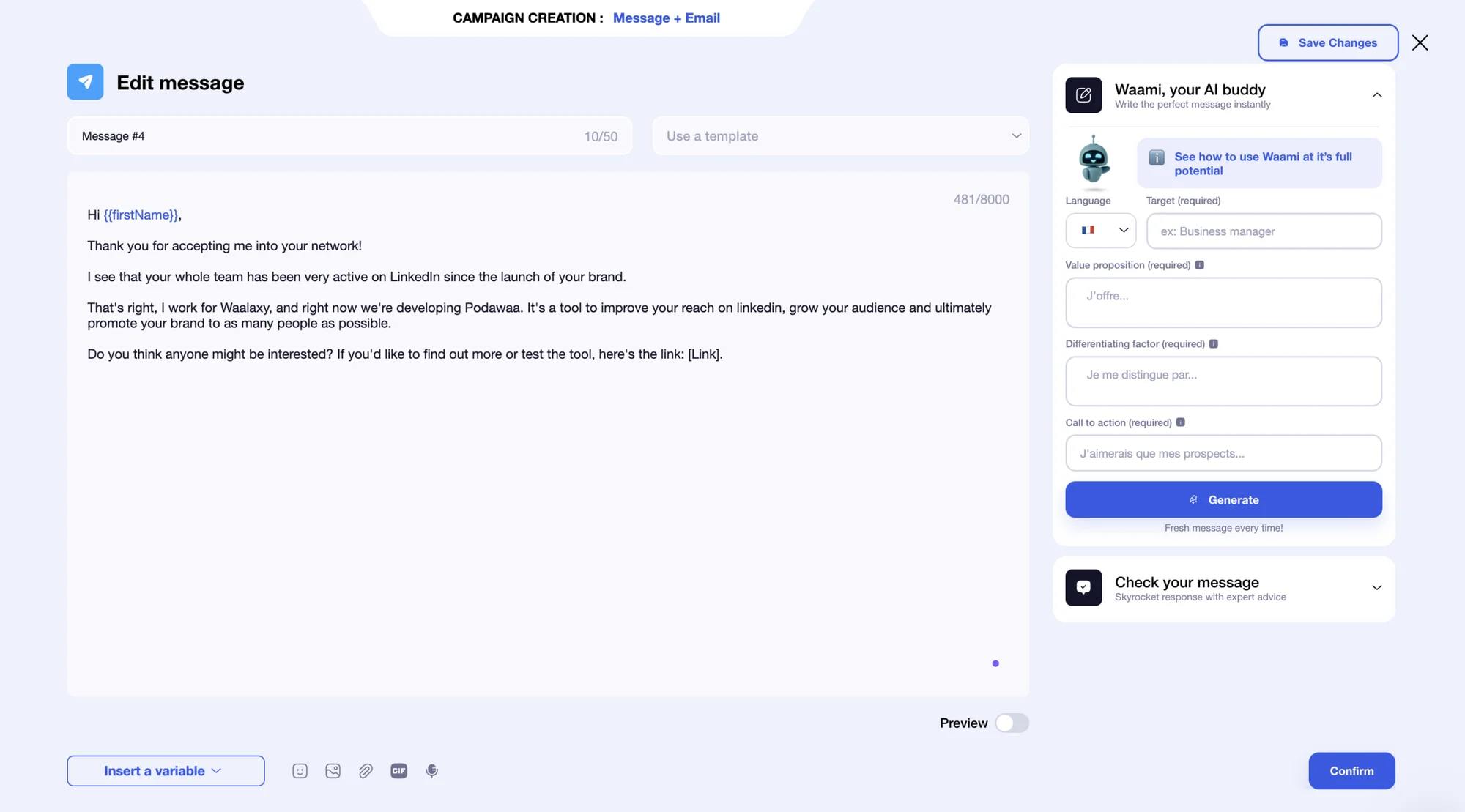
To write a LinkedIn prospecting message that gets replies, stick to three rules: one line of context, an open question, and no pitch in the first message. With Waalaxy, the "Invitation + 2 Messages" template sends all of this for you and stops as soon as the prospect replies.
Need help with your first message? Generate a prospecting message in a few seconds with this free tool.

LinkedIn prospecting message generator
Describe what you sell and to whom: the tool writes your first message, focused on your target’s problem.
One limit to keep in mind: LinkedIn caps invitations at around 200 per week per account. So go for fewer invitations, but well targeted.
2. Social selling
Social selling means publishing useful content so your prospects know you before your first message even lands. Posts, newsletters, lives and carousels show your expertise and build trust.
Networking is part of it. Comment on your target's posts, reply in groups, congratulate people on a new role. When your invitation arrives later, your name already rings a bell. The catch? You need to stay consistent for several weeks before you see results.
3. Cold emailing
Cold emailing is still one of the core prospecting techniques in B2B. A good email is short, focused on one of the prospect's problems and ends with a single question. Sample subject line: "SDR follow-ups at Nova". Then three sentences: the context, the problem, an offer to talk for 15 minutes.
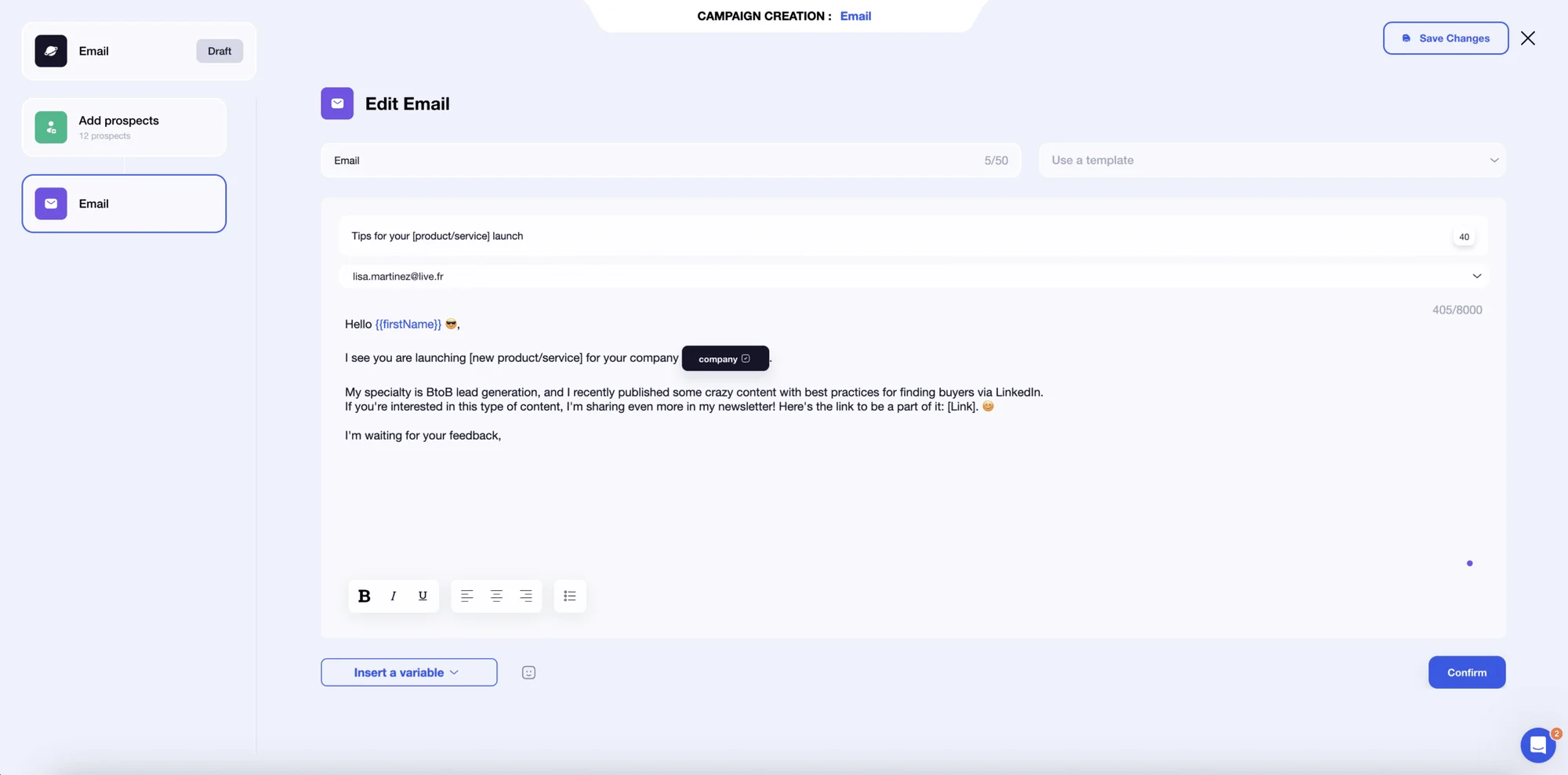
Think about repurposing. A LinkedIn post that performed well can become a useful follow-up email. You'll find more ideas in these cold email templates. And to find addresses, Waalaxy's Email Finder returns a work email for around 60% of LinkedIn profiles.
Also keep a visible unsubscribe link in every email. It's simple, and it protects your deliverability.
4. Multichannel prospecting (LinkedIn + email)
Multichannel prospecting adds more touchpoints across several channels in one sequence. The setup that works best in B2B: a LinkedIn invitation, two messages if it's accepted, then an email to the people who didn't accept or didn't reply.
The numbers speak for themselves. The average reply rate of Waalaxy campaigns is 16.6%, and the best strategies reach 47.8%. The difference mostly comes from targeting, the message and well-spaced follow-up messages on LinkedIn, from a few days to a week apart. ✅
Personalize first, automate second. A poorly targeted multichannel sequence just sends bad messages faster.
With Waalaxy, the sequence runs in the Cloud, even with your computer switched off, and each prospect leaves the campaign as soon as they reply.
5. Intent signal prospecting
This technique means reaching out to people at the moment they show interest. A buying signal can be a visit to your profile, a comment on your post, an invitation you received or a new job.
Your message then feels natural: "Thanks for your comment on my post about follow-ups, is that a headache for you too?" Buyer intent data takes it further with browsing or search data. With Waalaxy, Auto-import pulls these profiles in for you, from a saved Sales Navigator search, your profile visitors or the people who comment on your posts.
6. Inbound: content, SEO and lead magnets
With inbound, you create content that draws your prospects in: blog posts, guides, webinars, templates. A lead magnet (a white paper, a checklist) is exchanged for an email address and fills your database with warm prospects.
The upside is clear: the people who come to you already have a need. So is the limit, since organic search takes several months to pay off. Pair it with an outbound technique so you're not sitting around waiting. 📈
7. AI prospecting agents
A prospecting agent is an AI that handles prospecting from start to finish: finding the right profiles, writing the messages, replying to prospects. That's different from an automation tool, which runs the strategy you've defined. AI for sales prospecting is mostly for people who are short on time or have never been trained to prospect.
That's the idea behind Waalaxy AI, an autonomous LinkedIn prospecting agent, separate from Waalaxy. You share what you sell. The agent finds prospects, writes the messages, runs the conversation, and you're the one who closes. You pick your level of autonomy: Assisted, where you approve every message, Semi-autonomous, where you only approve its replies, or Autonomous. Waalaxy AI costs $100 per LinkedIn account per month, with a 14-day free trial.
8. Text message prospecting
Text messages work best as a quick follow-up after a first exchange, or in B2C and local businesses. They get read fast, but they also feel more intrusive than email.
Save them for prospects who already know you, with a two-line message and a clear sender name. The rules are the same as for email: prior consent in B2C, right to opt out in B2B.
Traditional prospecting techniques
Traditional prospecting techniques are far from outdated. They create direct human contact, which really helps with complex or local sales. Their main limit is the time they take. 🗣️
9. Phone prospecting (cold calling)
Cold calling means phoning prospects who aren't expecting you. You get instant feedback and can qualify a need in two minutes. Sample opener: "Hi Mark, I saw your agency is opening in Austin. I'm calling for 30 seconds to ask how you plan to land your first clients there."
Prepare answers to the most common objections, because objection handling often makes the difference between a no and a meeting. When you call consumers in the UK, also check your numbers against the Telephone Preference Service, the opt-out list for sales calls.
10. Field prospecting (door-to-door, in-person meetings)
Field prospecting happens face to face: door-to-door, company visits, on-site demos. It builds strong trust and works well for a local offer or a high-ticket deal.
It costs a lot of time and travel. To get clients in the field without wasting whole days, plan a targeted route and book meetings ahead by phone or on LinkedIn.
11. Trade shows and business events
A trade show brings your target together in one place on one day. To turn it into clients, everything happens before and after. Spot the exhibitors and attendees, contact them the week before to set up a chat, then follow up within 48 hours.
LinkedIn events work the same way online. With Waalaxy, you can import the attendees of a LinkedIn event and send them a personalized invitation that mentions the event.
12. Referrals and word of mouth
Referrals are the cheapest technique and often the one that converts best, because the prospect arrives with the trust of the person who recommended you. The problem is that people forget to ask. 🫶
Ask your happy customers who they know, set up a simple referral program, and collect visible recommendations and endorsements on LinkedIn. The right moment is just after you've delivered a result for your client.
Comparing and choosing prospecting techniques
You now have 12 prospecting techniques at hand. The next question is which ones to test first. The table below compares the main prospecting channels on simple criteria, then we'll look at how to choose based on your situation.
Prospecting channels compared
Read this table as a decision aid, not a ranking. It complements the overview of customer acquisition channels, since cost, time and lead time vary with your market.
Technique | Target | Cost | Time needed | Time to results | Personalization | Can be automated |
|---|---|---|---|---|---|---|
LinkedIn (invitation + messages) | B2B | Low | Low | Short | High | Yes |
Social selling | B2B | Low | High | Long | Medium | No |
Cold emailing | B2B | Low | Low | Short | Medium | Yes |
LinkedIn + email multichannel | B2B | Medium | Low | Short | High | Yes |
Intent signals | B2B | Low | Medium | Short | High | Partly |
Inbound and lead magnets | B2B and B2C | Medium | High | Long | Low | Partly |
AI prospecting agent | B2B | Medium | Very low | Short | High | Yes |
Text messages | B2C and local | Medium | Low | Short | Low | Yes |
Phone | B2B and B2C | Medium | High | Immediate | High | No |
Field sales | Local | High | Very high | Medium | Very high | No |
Trade shows and events | B2B | High | High | Medium | High | Partly |
Referrals | B2B and B2C | Very low | Low | Varies | Very high | No |
Put simply, digital techniques win on cost and volume, while traditional techniques win on the depth of the relationship.
What is the best prospecting technique?
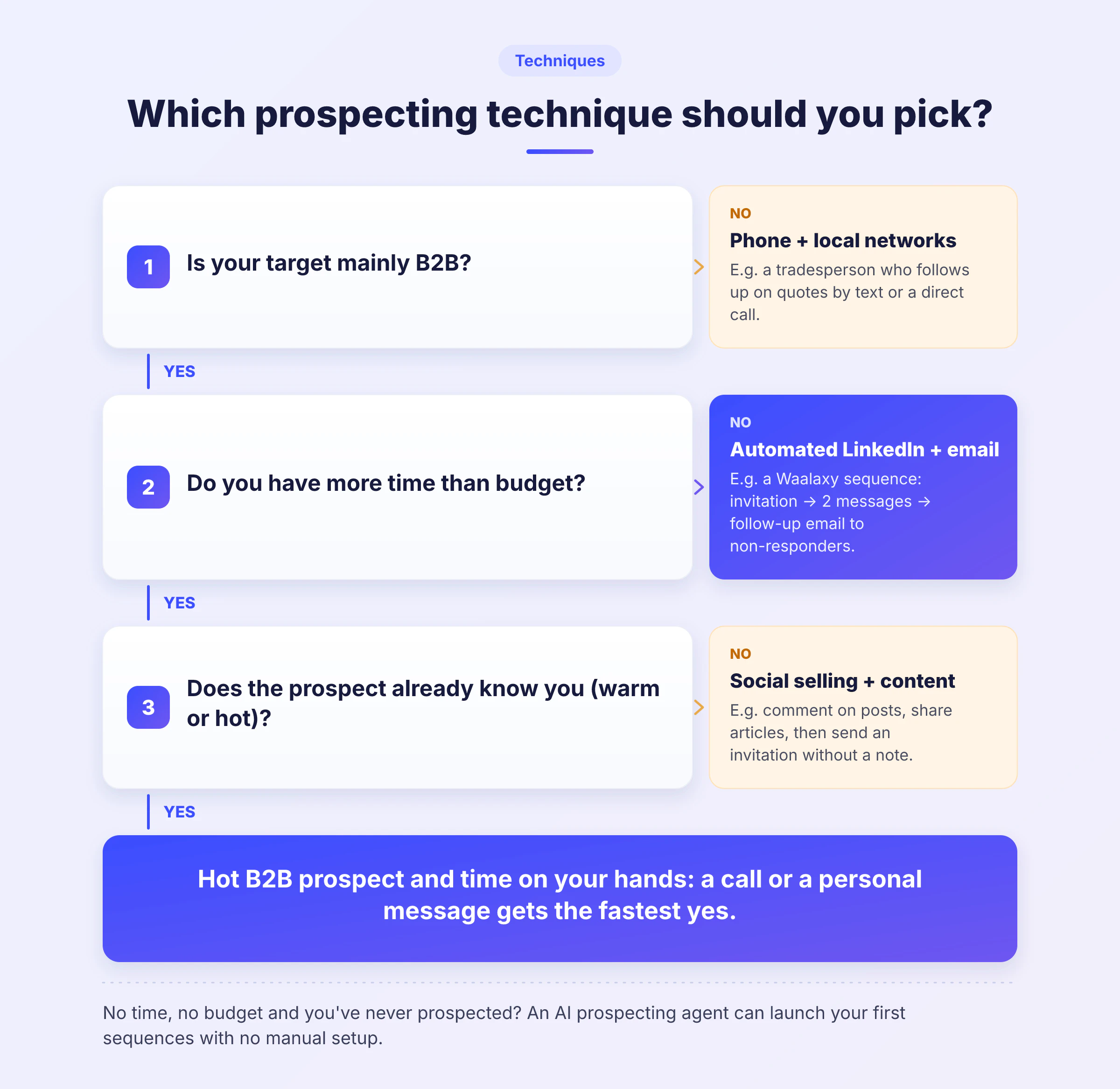
There's no single best prospecting technique for everyone. What works best is a multichannel mix chosen with three criteria in mind: your target, how warm the prospect is and your resources. To turn that choice into a step-by-step action plan, follow the method for a prospecting campaign.
Based on your target (ICP)
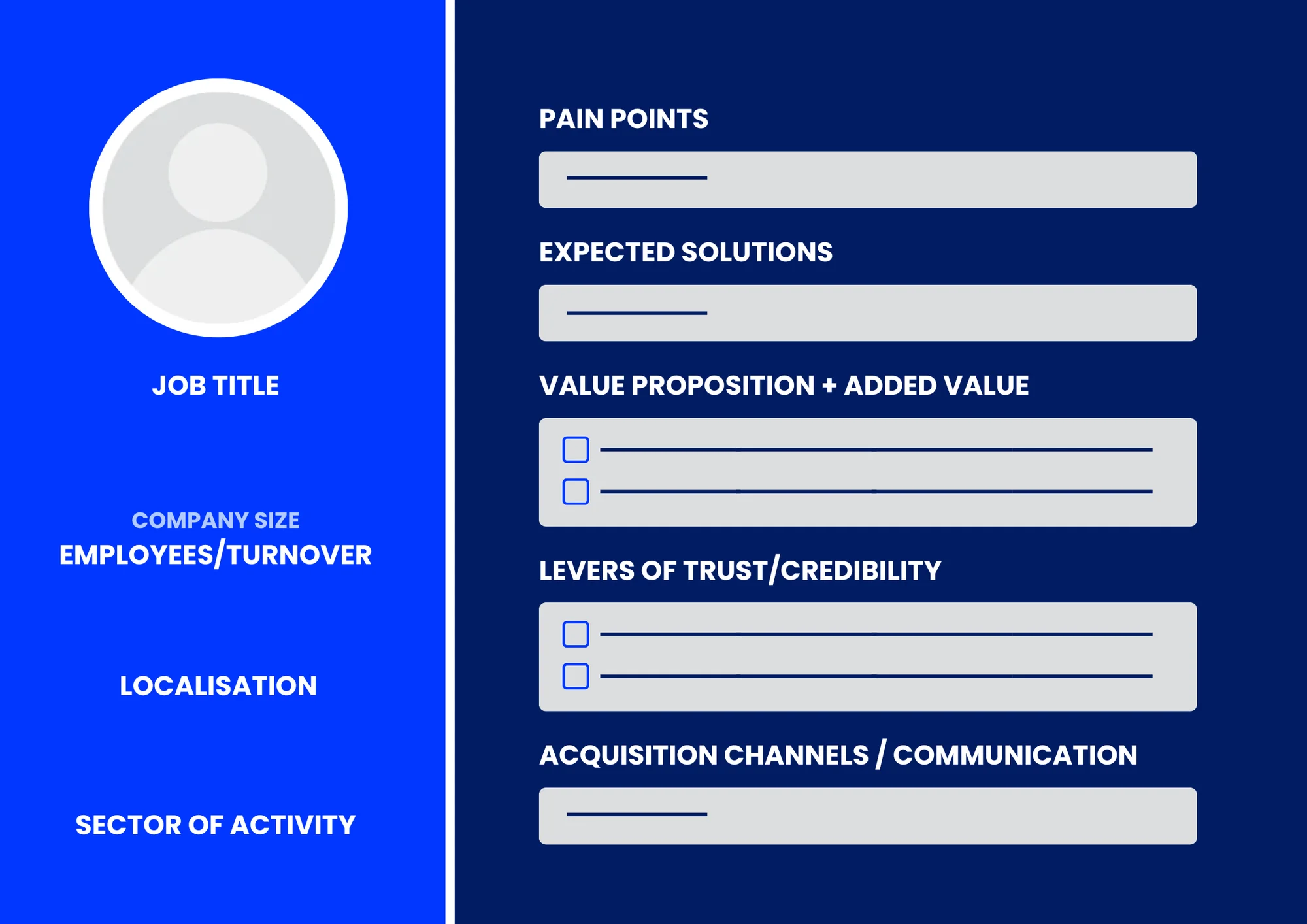
Start by describing your ideal customer profile: industry, company size, job title, main problem. Then ask yourself where these people spend their time. In B2B, that's often LinkedIn and email. For a local business, it's more likely field visits and the phone.
The easiest way? Generate your ICP for free, in one click. 👇

ICP Generator
Describe your product, the problem it solves and your industry: AI suggests your 3 ideal customer profiles, with the decision-maker to reach on LinkedIn.
Based on how warm the prospect is
A cold prospect doesn't know you. They respond better to educational content or a light message that asks a question. A warm prospect has already interacted with you, and a personalized follow-up is often enough. A hot prospect has shown a need, and that's when a call or a meeting request is the right technique.
Based on your resources (time, budget, team)
If you're solo or a founder, time is what you lack most. Bet on one or two techniques you can automate, such as LinkedIn and email, or hand the work to an agent. With a sales team, you can split the roles: SDRs handle outbound, marketing feeds inbound. Either way, automate the repetitive work and save your energy for conversations. 💡
Building your prospect list and measuring results
A prospect list and a dashboard aren't techniques. They're the two must-haves without which no prospecting technique delivers lasting results.
Building and segmenting your prospect list
Your prospecting file holds the useful details on each prospect: name, company, job title, email, industry. Don't buy a ready-made list, because the data is often outdated and consent is questionable. A list built by hand also contains 30% false positives, which is why checking it carefully matters.
Import your prospects automatically from a LinkedIn or Sales Navigator search.
Clean up the list: duplicates, off-target profiles, companies that are already customers.
Segment your lists by industry, company size or how warm prospects are.
Add tags to prioritize the most promising prospects.
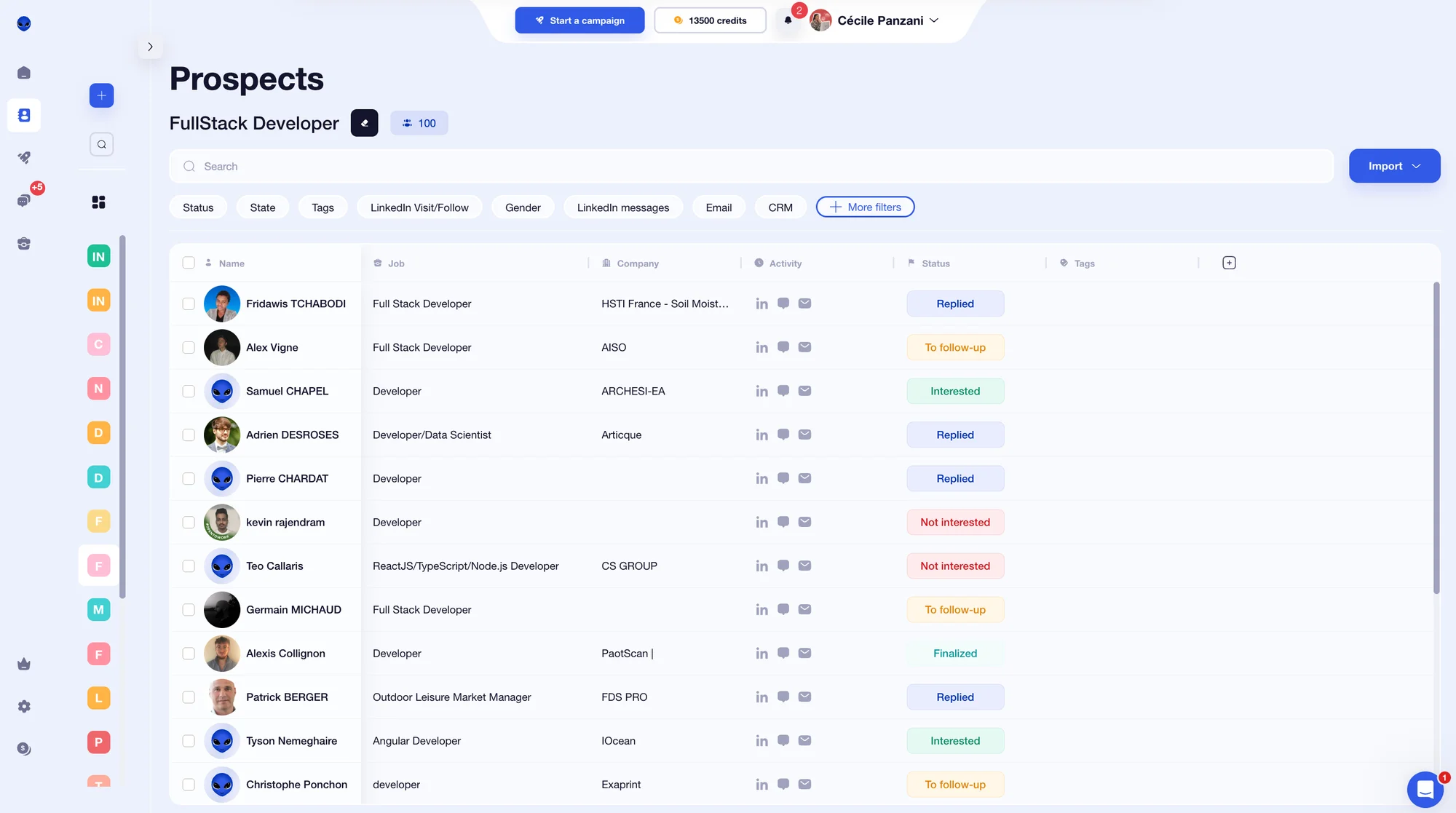
A clean list saves you time on every technique that follows. 🧼
KPIs to track for each technique
Each technique has its own metrics. Track them every week to know what to fix, and check out these LinkedIn KPIs to go further.
Metric | Technique | What it tells you |
|---|---|---|
Acceptance rate | Whether your targeting and profile make people want to connect | |
Open rate | Whether your subject line and deliverability hold up | |
Reply rate | LinkedIn, email, text messages | Whether your message really speaks to the prospect |
Meeting rate | All | Whether your conversations are moving toward a sale |
Conversion rate | All | How many prospects become customers |
Change only one thing at a time, the target, the message or the delay, otherwise you won't know what moved your numbers. 📊
Tools to automate your prospecting techniques
Sales prospecting tools fall into four families: a CRM to track your deals, data enrichment tools to find emails and phone numbers, sales engagement tools to send your sequences, and now AI agents.
Waalaxy automates your prospecting techniques on LinkedIn and by email. In practice, it helps you:
Import your prospects from LinkedIn, Sales Navigator or a CSV file.
Find their work emails with the Email Finder.
Launch multichannel campaigns from ready-made templates.
Manage all your replies in one place with the Inbox.
Sync your prospects with HubSpot, Pipedrive or your CRM through Zapier.
The difference with Waalaxy AI is simple. With Waalaxy, you choose your target and write your messages, and the tool does the rest. With Waalaxy AI, the agent also builds the strategy and runs the conversations on LinkedIn. And if you've never automated your prospecting, you're in good company: 75% of Waalaxy customers had never done automated prospecting before. The trial lasts 14 days, no credit card needed.
Prospecting techniques: key takeaways
The most effective prospecting techniques are the ones you combine and measure. In B2B, automated LinkedIn and email gets conversations going fast, social selling and inbound build trust over time, and the phone, trade shows or referrals bring the human contact that closes deals.
Pick two techniques that suit your target, prepare a clean list, track your KPIs every week and adjust. Then automate what eats up your time, so you keep your energy for the conversations that matter. Over to you! 👽
FAQ: prospecting techniques
There are three main families. Each one groups several techniques that work well together:
Digital: LinkedIn, social selling, cold emailing, multichannel, intent signals, inbound, AI agent, text messages.
Traditional: phone, field sales, trade shows and events, referrals.
Multichannel: a sequence that combines several channels to add touchpoints.
In B2B, combining LinkedIn and email is often the best place to start, because it's cheap and easy to automate.
In B2B prospecting, the most effective technique is usually multichannel: a LinkedIn invitation, a few messages, then a follow-up email. You reach each prospect on two channels without doubling your workload. The average reply rate of Waalaxy campaigns is 16.6%, and it climbs to 47.8% for the best strategies. Targeting and the quality of the message remain the two levers that make the difference.
The strategy sets the direction: who you target, with which offer and which goals. The method organizes the work over time, with steps, a schedule and follow-ups. The technique is the concrete action on a channel, like a call, an email or a LinkedIn invitation. Good prospecting lines up all three, otherwise you risk applying good techniques to the wrong target.
Start small and focused. To prospect new customers without spreading yourself too thin, follow these steps:
Define a precise target, just one type of customer to start with.
Choose one main channel, LinkedIn in B2B, plus one follow-up channel.
Write a short message about the prospect's problem.
Measure your replies every week and adjust.
If you've never prospected, an agent like Waalaxy AI can handle the targeting, the messages and the conversations, while you stay in charge of closing.
The rules depend on your target. In B2B, you can usually email a prospect without their prior consent, as long as the message relates to their job and they can easily opt out of future emails. In B2C, you need their prior consent for email and text messages. In every case, say clearly who you are, explain where their data comes from and include an unsubscribe link. For B2C calls in the UK, check the Telephone Preference Service before you dial. Rules vary by country, so check the law of the market you prospect.
Yes, a good part of them. LinkedIn invitations, messages, follow-ups and emails are easy to automate with a tool like Waalaxy, which runs in the Cloud. Some techniques stay manual: field sales, trade shows, calls and asking for referrals. The ideal is to automate the repetitive work so you can spend your time on real conversations. An AI prospecting agent goes further, by also writing the messages and replying to prospects.