
A prospecting campaign launched without a plan usually ends the same way: dozens of invitations sent, three replies, and nobody knows who to follow up with. 😅 A campaign that works rests on four things: a precise target, a relevant message, a follow-up sequence and metrics you check every week. Your prospecting plan lines up those four pieces before you hit "launch". In this guide, you'll get the 7 steps to build it, a week-by-week LinkedIn and email campaign example, and the mistakes that sink results.
What is a prospecting campaign?
A prospecting campaign is a set of coordinated actions, run over a set period and aimed at a defined target, to reach a measurable goal. That goal can be meetings, demos or sales. It has a start and an end, a message written for one specific segment and success metrics set in advance. 🎯
That's what sets it apart from ad hoc sales prospecting, where you reach out to profiles whenever an idea strikes. Without a framework, you can't tell what worked. With a campaign, you can compare, adjust and repeat what gets results.
You decide on these five ingredients upfront, in a broader document called the prospecting plan. Here's how the two differ.
Prospecting campaign vs prospecting plan: what's the difference?
People mix them up all the time. Your prospecting plan is your roadmap for a quarter or a year. It sets the goals, targets, channels and resources. A prospecting campaign carries out one part of that plan, on one segment, over a few weeks. The plan itself flows from your B2B lead generation strategy.
Criteria | Prospecting plan | Prospecting campaign |
|---|---|---|
Timeframe | A quarter or a year. | 2 to 8 weeks. |
Scope | Overall goals, targets, channels, budget, team. | One segment, one sequence, messages, a schedule. |
Output | A shared steering document. | A live sequence and a tracking sheet. |
One prospecting plan spawns several campaigns, one per segment or offer. It fits into your wider sales planning, which also covers customer retention and account management.

Your prospecting agent at half price, for life
€100€50/month, annual plan
Nov 27 12am to Nov 28 noon CET
Discover Waalaxy AI →14-day free trial
Types of prospecting campaigns
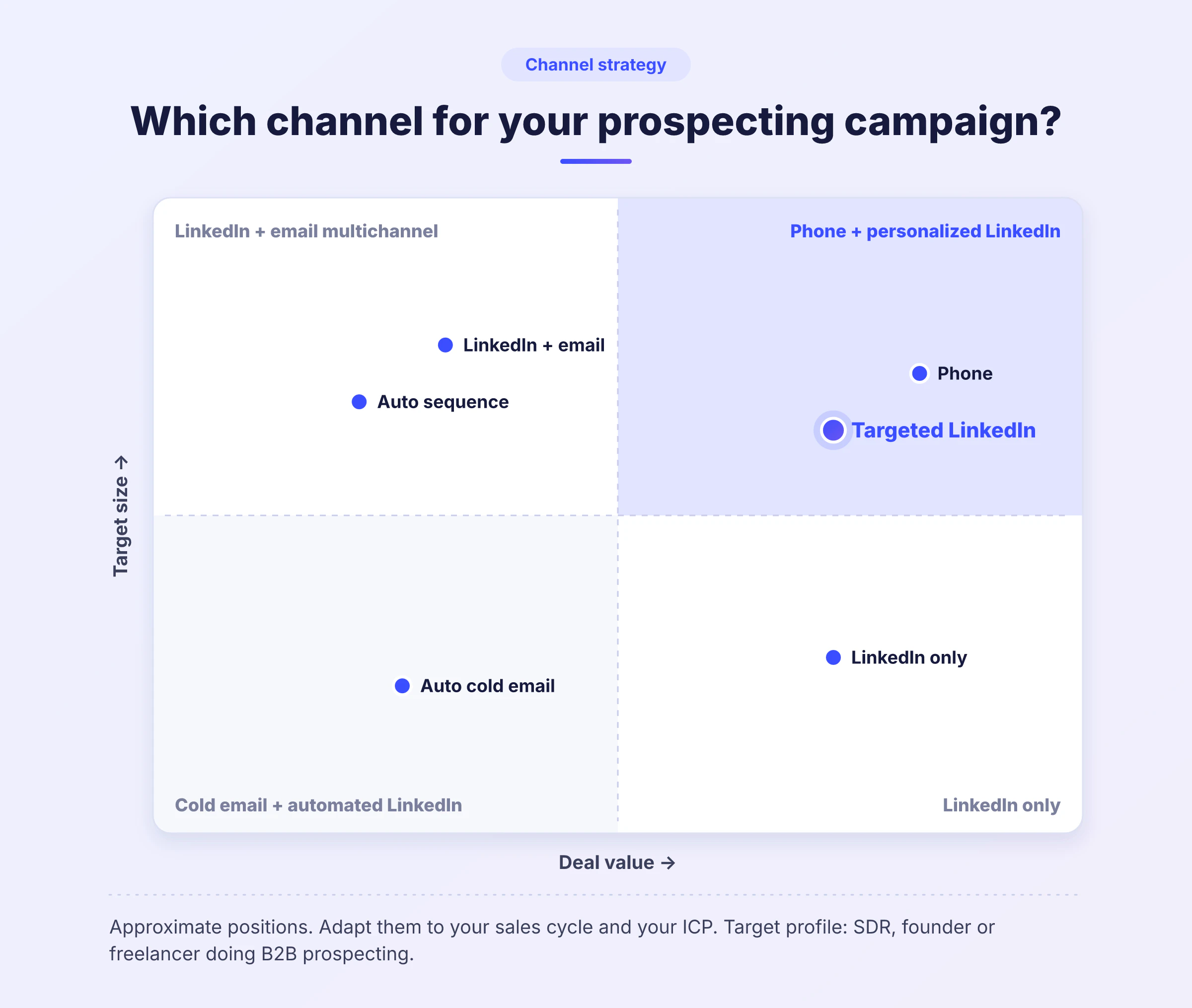
Each channel has its strengths. The right pick depends on your target, your sales cycle and how much time you have. The table below sums up when to use each type of prospecting campaign, plus the metric to watch first. For a closer look at each approach, check out the most common sales prospecting techniques.
Channel | When to use it | Upside | Limit | Key KPI |
|---|---|---|---|---|
LinkedIn (invitations and messages) | B2B target you can identify by job title and company. | Up-to-date profiles, context visible before you reach out. | Weekly invitation limits. | Acceptance rate. |
Cold email | You have work emails and want more volume. | No LinkedIn limits, scheduled sending. | Deliverability and spam filters. | Reply rate. |
Phone | Complex offer or a target that picks up. | Direct conversation, objections handled live. | Time-consuming, numbers hard to find. | Meetings booked. |
LinkedIn and email multichannel | You also want to reach people who don't accept your invitation. | More touchpoints for the same list. | Needs a well-timed sequence. | Replies per channel. |
Inbound as support | You publish content on the side. | Prospects already know you. | Slow results. | Profile views. |
A few use cases to help you choose. An HR consultant targeting HR directors at SMBs starts on LinkedIn, because the job title is easy to filter and their prospects are active there. A SaaS company that already has a list of addresses follows up with a short cold email campaign. A firm selling a $20,000 audit keeps the phone for key accounts. 📞
In most B2B cases, a multichannel campaign, LinkedIn first and then email, gets the most replies, because it catches prospects who didn't see or didn't accept your invitation. That's the format we break down in the example further down.
How to build a sales prospecting plan in 7 steps
Here's the method to go from a vague idea to a prospecting campaign that's ready to launch. Each step ends with a concrete deliverable. If you don't have it, don't move on to the next one. 👇
1. Set SMART goals
A good goal is specific, measurable, achievable, realistic and time-bound. "Find clients" doesn't work. "Book 10 meetings with HR directors at SMBs in 6 weeks" does, because you know exactly what to count. That's how your overall customer acquisition or revenue goals turn into campaign goals.
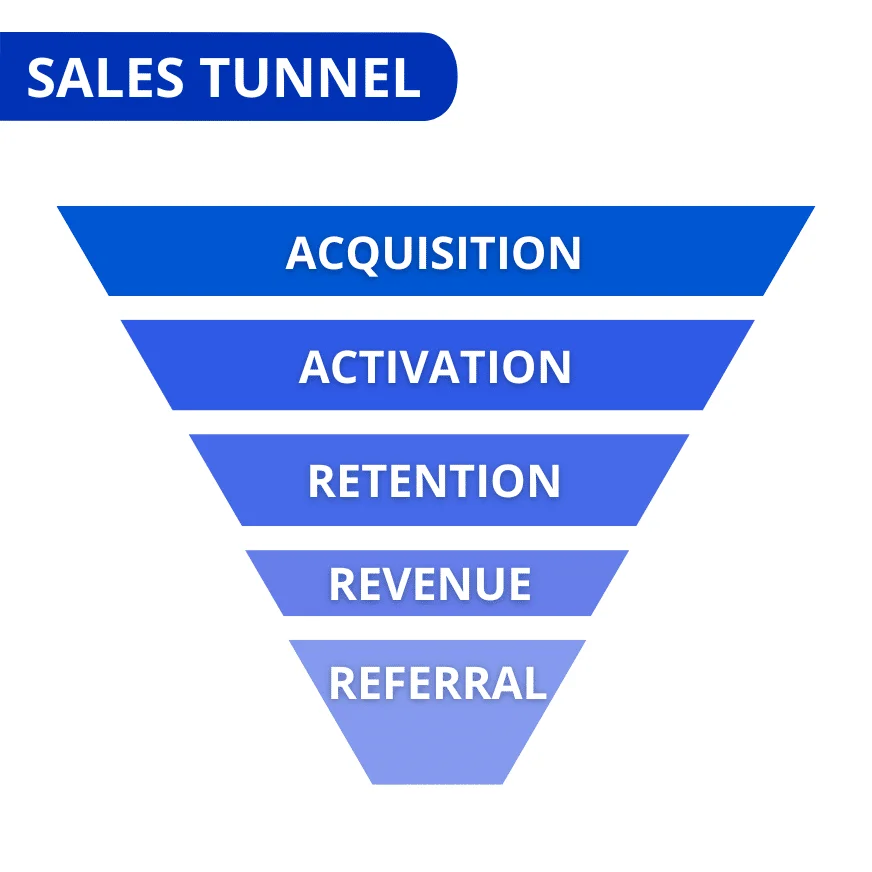
Next, work your prospecting funnel backwards. For 10 meetings, how many positive replies do you need? For those replies, how many accepted invitations, and how many invitations sent? As a benchmark, the average reply rate of Waalaxy campaigns is 16.6%, and the best strategies reach 47.8%. For everything else, start from your own numbers from past campaigns.
By the end of this step, you have a numeric goal and the number of prospects to contact to hit it.
2. Define your ICP and persona
In B2B, you start with the ideal company, then narrow down to the person. Your ideal customer profile describes the type of company that buys from you. Your persona describes the person who signs or influences the decision. In practice, write down:
The industry and company size.
The job title and seniority of the decision-maker.
The problem they face and what they've already tried.
The buying trigger: a funding round, a hiring push, a new role, a new regulation.
The reasons they'd pick a competitor over you.
No need for age, family situation or hobbies: in B2B, they don't help you write a better message. If you're starting from scratch, the generator below gives you a first version of your ICP. 🧠

ICP Generator
Describe your product, the problem it solves and your industry: AI suggests your 3 ideal customer profiles, with the decision-maker to reach on LinkedIn.
By the end of this step, you have a one-page ICP sheet and one or two personas.
3. Segment your target
One target hides several situations. An HR director hiring 30 people a year doesn't have the same worries as one handling layoffs. So split your target into segments using three sets of criteria:
Firmographics: industry, headcount, location, growth.
Role and level: function, tenure, role in the decision.
Intent signals: the person visited your profile, commented on a post, changed jobs or recently accepted an invitation.
Keep the rule one segment, one message in mind. If two segments get the same text, you haven't really segmented. By the end of this step, you have 2 or 3 priority segments, ranked by potential.
4. Build your prospect list
This is where your target becomes a list of names. On LinkedIn, use the advanced search filters or LinkedIn Sales Navigator to isolate the right profiles, then import them into Waalaxy in one click. Auto-import can also add new results from a saved search, or the people who comment on your posts, without you lifting a finger.
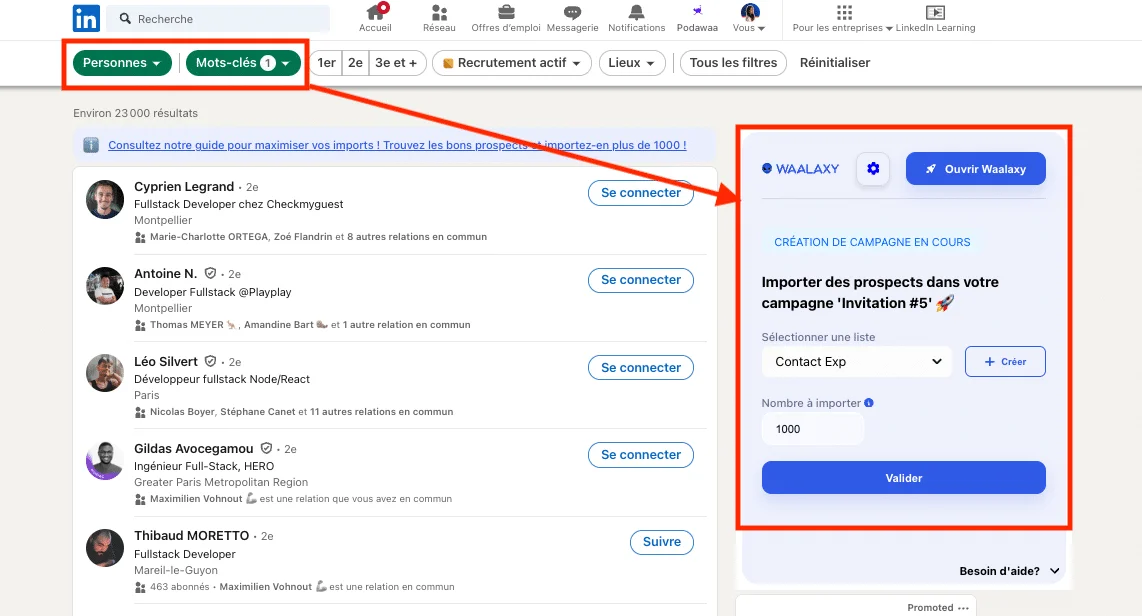
For each prospect, keep the essentials in your prospecting file. Here's a stripped-down version of what it looks like:
Field | Example |
|---|---|
Company | ABC Industries, 80 employees, manufacturing. |
Decision-maker and role | John Smith, Head of Procurement. |
Work email | Found with the Email Finder. |
Segment | Manufacturing, 50 to 200 employees. |
Status | Invited on Monday, follow-up planned for day 4. |
Waalaxy's Email Finder enriches profiles in cascade and returns a work email for around 60% of them. Still, check a sample of your list by eye: a hand-built list contains on average 30% false positives, meaning profiles that don't fit your target.
By the end of this step, you have a clean, segmented and enriched list, ready to go into a sequence.
5. Choose your channels and sequence
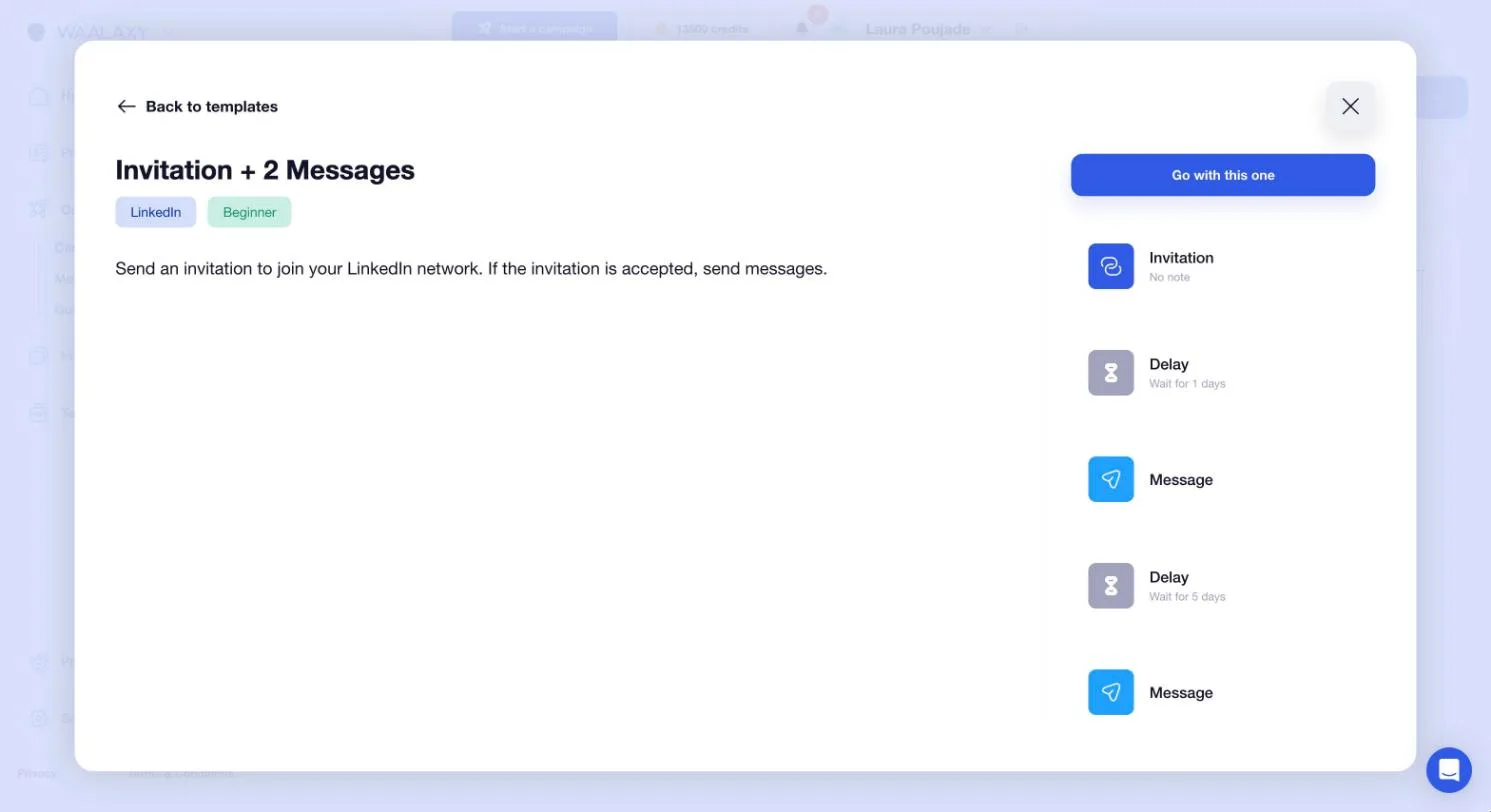
A sequence is the chain of actions and the delays between them. In Waalaxy, you pick it from a catalog of ready-made templates, like "Invitation + 2 Messages". Here's an example of a multichannel sequence for a B2B prospecting campaign:
Day 1: profile visit, so you show up in their notifications.
Day 2: invitation, with or without a note.
Once accepted: first message, short and focused on their problem.
4 to 5 days later: a LinkedIn follow-up message that brings something new.
If the invitation isn't accepted after a few days: find their email address and send a follow-up email.
Everything runs in a single queue, and as soon as a prospect replies, they leave the sequence so you can pick up the conversation yourself. To compare the available templates, take a look at the Waalaxy sequence that fits your goal.
By the end of this step, you have a sequence picked out, with its delays and a backup channel for people who don't accept. ⏱️
6. Write messages that make people want to reply
A good LinkedIn prospecting message comes in four parts: a personalized hook, the prospect's problem, your value proposition and a low-pressure call to action. No pitch in the invitation. You're asking for a connection, not a signature.
For the email part, adapt a cold email template to your segment instead of starting from a blank page. And if you get stuck, Waami, the AI writing assistant built into Waalaxy, gives you a first draft based on your target, your value proposition, what sets you apart and your call to action. ✍️
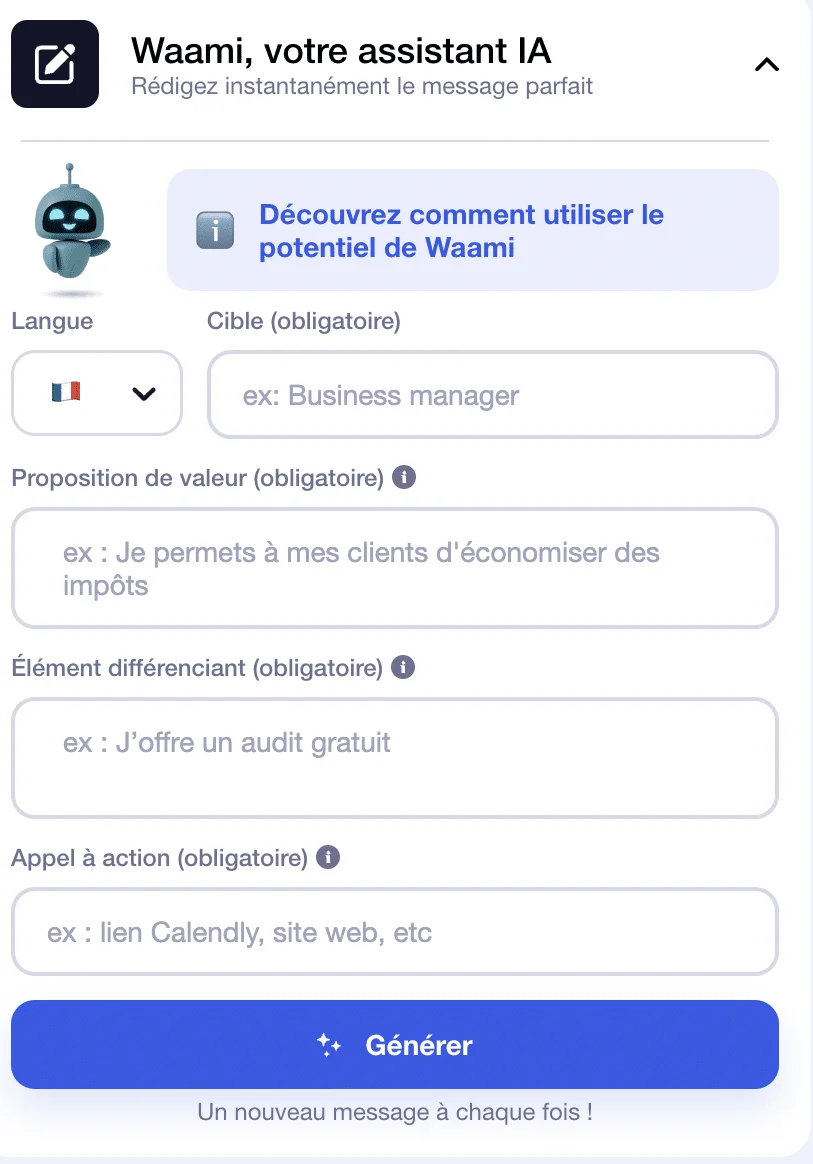
By the end of this step, you have an invitation, two LinkedIn messages and one email per segment.
7. Track your KPIs and adjust
Measure what happens at each stage of the funnel, not just the final revenue. Here are the performance indicators to track for every campaign:
KPI | What it measures | If it's low |
|---|---|---|
Acceptance rate | How relevant your target and your profile are. | Rework your targeting or your LinkedIn profile. |
Reply rate | How interesting your first message is. | Rewrite the hook and make it shorter. |
Positive reply rate | How well your offer fits the segment. | Change the angle or the segment. |
Meetings booked | How well you turn interest into action. | Offer a simpler call to action. |
Cost per meeting | The time and money spent per meeting. | Automate the repetitive tasks. |
To put your numbers in context, go back to the benchmarks above: a 16.6% average reply rate, and 47.8% for the best strategies. LinkedIn KPIs and emailing KPIs read differently, so track them separately.
And when a prospect becomes a customer, the campaign isn't over. Loyalty and word of mouth from your first customers feed your next campaigns, with real cases you can mention in your messages. 📈
Prospecting plan example for a LinkedIn and email campaign
Let's get concrete with a running example. A recruitment agency targets HR directors at SMBs with 50 to 200 employees. Its goal is 10 meetings in 6 weeks. Here's its prospecting plan example, week by week. The volumes are only there for illustration, so swap in your own.
Week | Action | Target and volume | KPI to watch | Adjustment point |
|---|---|---|---|---|
W1 | Build the list, write the messages, approve the sequence. | 2 segments, 300 profiles in total. | List quality. | Remove off-target profiles. |
W2 | Launch segment 1: visit, invitation, message. | 150 profiles. | Acceptance rate. | Tweak the invitation note. |
W3 | Launch segment 2 and the segment 1 follow-ups. | 150 profiles. | Reply rate. | Rewrite the hook if needed. |
W4 | Email the non-accepters from both segments. | Non-accepters. | Replies per channel. | Compare LinkedIn and email. |
W5 | Follow-ups and meeting booking. | Prospects who replied. | Positive replies. | Simplify the call to action. |
W6 | Review and prep for the next campaign. | The whole campaign. | Meetings, cost per meeting. | Keep the best segment. |
This schedule shows why a prospecting campaign in two waves pays off. Segment 2 benefits from what segment 1 taught you, and email catches the people who didn't accept the invitation. 💡 You can reuse this template as is and just change the target, the volume and the goal.
To run this plan without spending your days copy-pasting messages, Waalaxy automates the visits, invitations, messages and follow-up emails. The trial is free for 14 days, no credit card required.
Tools to launch your prospecting campaign
You have two options, depending on what you already have in hand. If your strategy is ready and you want to run it faster, Waalaxy takes care of the repetitive work. If you've never prospected and want someone to build the strategy with you, an AI agent takes over.
Launch your prospecting campaign with Waalaxy
Waalaxy is a prospecting automation tool that runs through a Chrome extension and a web app. Campaigns run in the Cloud, even when your computer is off. Three steps are all it takes to get started:
Target your prospects on LinkedIn or Sales Navigator and import the list into Waalaxy.
Click "Start a campaign", then pick your sequence template and your list.
Write your messages, on your own or with Waami, then launch the campaign.
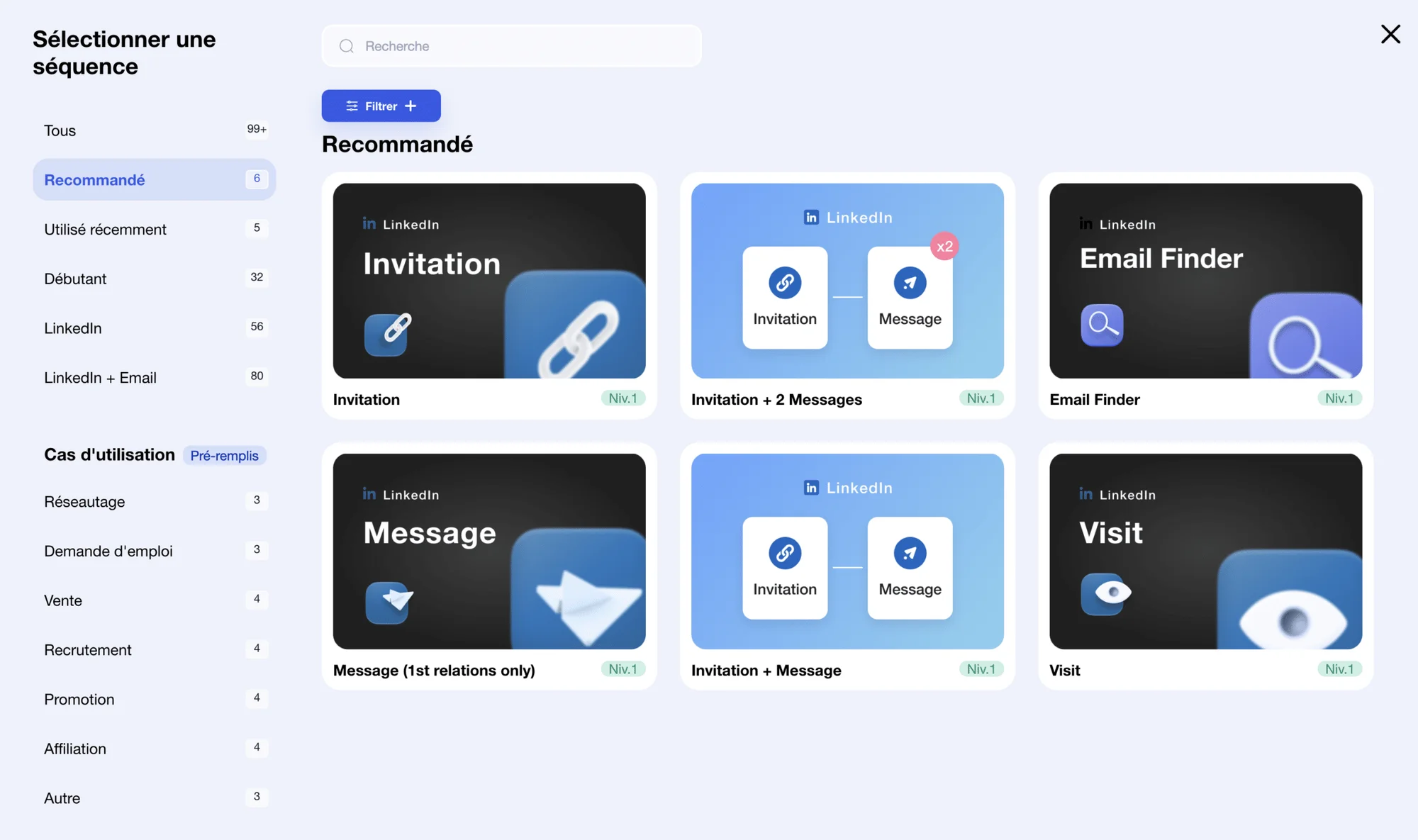
Replies then land in a single inbox, and you can sync your prospects with your CRM, like HubSpot or Pipedrive. For the detailed, screen-by-screen walkthrough, follow the tutorial to launch your first Waalaxy campaign. And if you're new to this, relax: 75% of Waalaxy customers had never done automated prospecting before. 👽
Hand your campaign over to an AI prospecting agent
You know how to sell your offer, but nobody ever taught you how to prospect? Waalaxy AI is built for you. It's an autonomous LinkedIn outreach agent, a separate product from Waalaxy, with its own app and its own subscription. Where Waalaxy runs the strategy you've defined, Waalaxy AI builds the strategy too. If AI agents sound interesting, here's how it works:
It reads your website and suggests 2 to 4 targets.
It finds prospects and filters out the ones that don't match the target.
It writes a personalized sequence for each prospect: an invitation, then 3 messages.
It runs the conversation, and you close when the prospect is ready.
You pick from three autonomy levels. In Assisted mode, the default, you approve every sequence and every reply before it goes out. In Semi-autonomous mode, the agent sends the sequences on its own and you approve its replies. In Autonomous mode, it sends and replies on its own, and only checks in with you when it needs context. It works on LinkedIn only, with no Chrome extension. It costs $100 per LinkedIn account per month, with a 14-day free trial.
You know your business. We know LinkedIn prospecting. Each to their own job.
To decide, keep this in mind. Go with Waalaxy if you already have your target and your messages and you want to save time. Go with Waalaxy AI if you want the agent to choose the target, write the messages and handle the conversations for you.
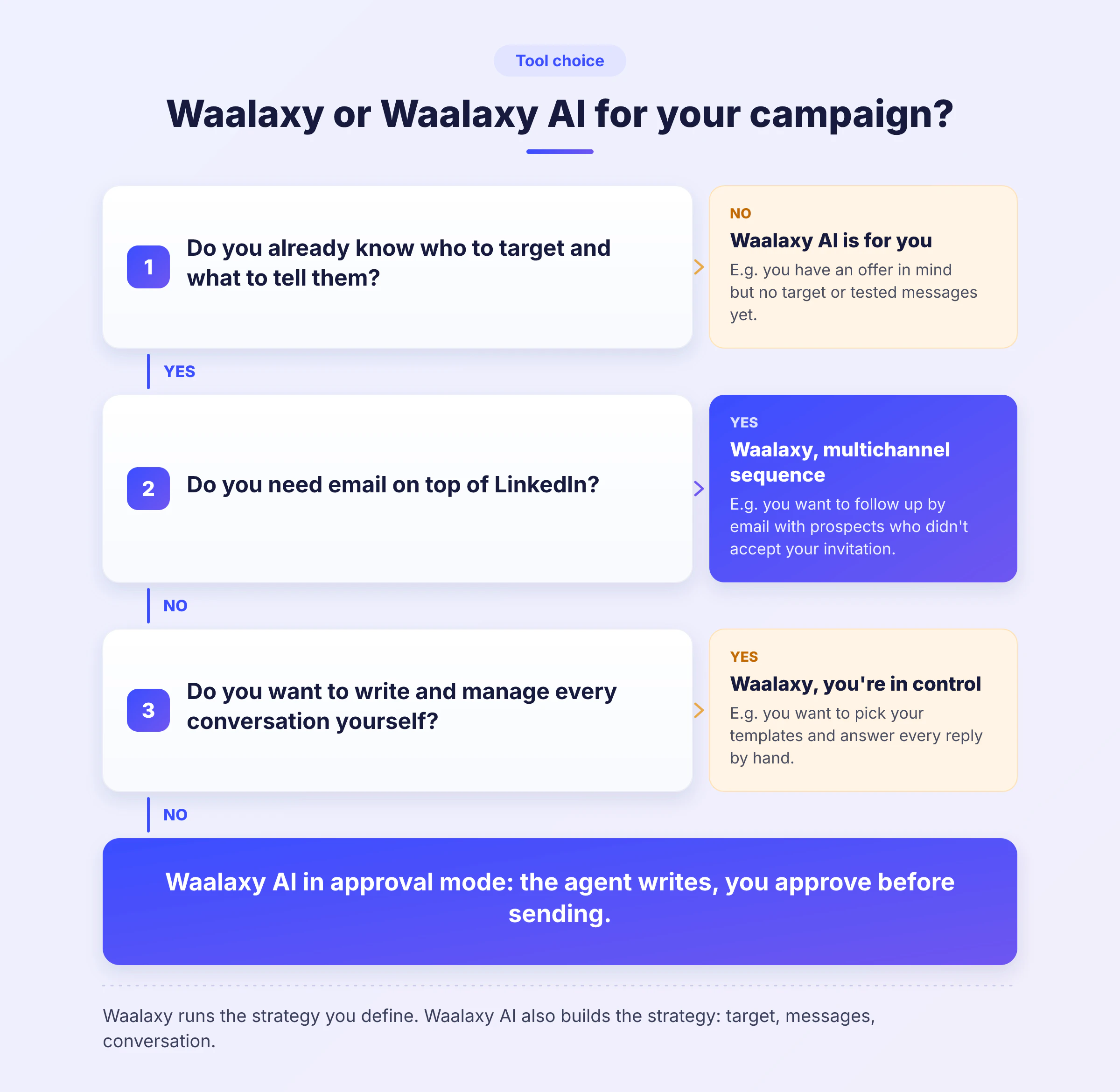
If the second branch sounds like you, you can test the agent on your own LinkedIn account for two weeks.
Mistakes to avoid in a prospecting campaign
Most campaigns that fail trip up on the same things. Run your prospecting campaign through this list before you launch it. 🚧
Target too broad: "SMB leaders" means nothing. Narrow it down to one industry, one company size and one job title.
Same message for everyone: each segment has its own problem, so it needs its own message.
No follow-up: without follow-ups, you lose everyone who saw your message at the wrong time.
Too many follow-ups: past two or three, following up turns into harassment.
Pitching in the invitation: your prospect doesn't know you yet, so build the connection first.
Measuring nothing: without KPIs, you repeat the same mistakes in your next campaign.
Ignoring limits: LinkedIn caps invitations at around 200 per week, whatever tool you use.
On that last point, staying within the LinkedIn invitation limit protects your account and pushes you to be pickier about who you contact. On the email side, the most common cold emailing mistakes are about the subject line, the length and deliverability.
One last trap is the unchecked list. With 30% false positives on average in a hand-built list, you waste a third of your invitations on people who will never buy. Ten minutes of sorting before launch makes a real difference to your results.
Before wrapping up, one reminder: a failed campaign isn't a lost campaign if you learn from it for the next one.
Prospecting campaign: key takeaways
A successful prospecting campaign isn't about how many messages you send. It comes from a clear prospecting plan: a SMART goal, a precise ICP, segments that each get their own message, a multichannel sequence and KPIs tracked every week. The six-week schedule in this guide gives you a base to adapt for your next campaign.
The hardest part is getting started. Pick a segment, write your invitation and launch a first wave this week. You'll adjust with real numbers instead of guesses. 🚀
FAQ: prospecting campaign
A good prospecting campaign starts with a numeric goal and a tight target. Then you write a different message for each segment and plan two follow-ups a few days apart. Finally, you track your acceptance rate and reply rate to correct course along the way. Most of the time, precise targeting makes the difference, well before writing skills do.
Short versions of the prospecting plan fit into five steps. The method in this guide has seven, because it separates the ICP from segmentation, and choosing the sequence from writing the messages. The five classic steps are:
Set measurable goals.
Define and segment your target.
Build your prospect file.
Contact prospects with a message and follow-ups.
Measure the results and adjust.
In B2B, the methods that get the most replies combine several channels. The most common ones are:
LinkedIn prospecting, to reach decision-makers with their context right in front of you.
Cold email, to reach a wider volume or catch people who didn't accept your invitation.
Phone, for high-value accounts.
Social selling, so your prospects know you before your first message.
The most effective method is still the one you measure and improve, campaign after campaign. The guide to LinkedIn prospecting explains how to get started on this channel.
As a rule of thumb, plan on 4 to 8 weeks for a B2B prospecting campaign. You need time to send invitations within LinkedIn limits, let the follow-up delays play out and book the meetings. Under two weeks, you don't have enough data to judge. Beyond two months, your list runs dry and your message wears thin, so you're better off launching a new campaign on another segment.
A prospecting action is a single touchpoint with a prospect: a profile visit, an invitation, a message, an email or a call. A campaign chains several actions in a set order with precise delays, which is what we call a sequence. The more these actions fit together, the more your prospect feels like they're in an ongoing conversation rather than on the receiving end of a string of requests. Once the campaign is over, remember to handle the prospects left after your first campaign who didn't reply.
Start with a polished LinkedIn profile, because it's the first thing your prospect looks at. Then target with search filters or Sales Navigator rather than random keywords. After that, stick to these rules:
A short invitation, with no pitch.
A first message focused on the prospect's problem.
One or two follow-ups that add something new.
A steady pace, within LinkedIn's limits.
Automating the repetitive tasks with a tool like Waalaxy frees up more time for the conversations that really matter.