
You prospect a lot, but your messages often miss the mark? The problem rarely comes from the message. It almost always comes from the target. In sales, your ideal customer profile (or ICP) describes the type of company that gets the most value from your offer, and so the one most likely to sign. A well-defined ICP in sales saves you time, aligns sales and marketing and makes your prospecting far more profitable. In this guide, you'll get a 6-step method to define your B2B ICP, the criteria that matter, concrete examples, a template to copy and, above all, how to turn your ICP into a LinkedIn search, by hand or with AI. 👀
What is an ideal customer profile in B2B?
An ideal customer profile is a detailed description of the company that makes your ideal customer: the one that has the problem you solve, the budget to solve it and the ability to decide fast. We're talking about a company, not a person. That's what sets it apart from a persona, which we'll cover right after.
In practice, an ICP for sales combines several criteria:
The company size (headcount, revenue).
The industry.
The location.
The tools it already uses.
The specific challenges and needs that make your offer relevant.
The goal is to focus your efforts on the accounts with the highest conversion potential. 🎯 With a clearly defined ICP, you adapt your sales prospecting approach and prioritize the prospects with a real chance of buying.
ICP for sales or ICP for marketing: what's the difference?
The difference comes down to the goal. An ICP for sales helps you identify and prioritize the companies to contact, based on criteria like size, industry, revenue or location. Its job is to qualify prospects and focus sales reps on the ones most likely to sign.
An ICP for marketing focuses more on motivations and behavior: interests, buying habits, preferred acquisition channels. Its job is to tailor messages to pull these accounts into the sales cycle. Both start from the same ideal customer profile. They just use it differently. 🔄
Why define your ICP in sales?
When you target the companies that need your solution most, you make the most of your time, your resources and your chances of converting. The table below sums up what you get out of it.
Reason | What you get |
|---|---|
Target the right prospects | Your efforts go to the companies most likely to buy. |
Save time | You shorten sales cycles by avoiding unqualified prospects. |
Align sales and marketing | Both teams go after the same accounts, with the same message. |
Spend your budget better | Your resources go to the most profitable prospects. |
Improve your conversion rate | You talk to companies that actually need your solution. |
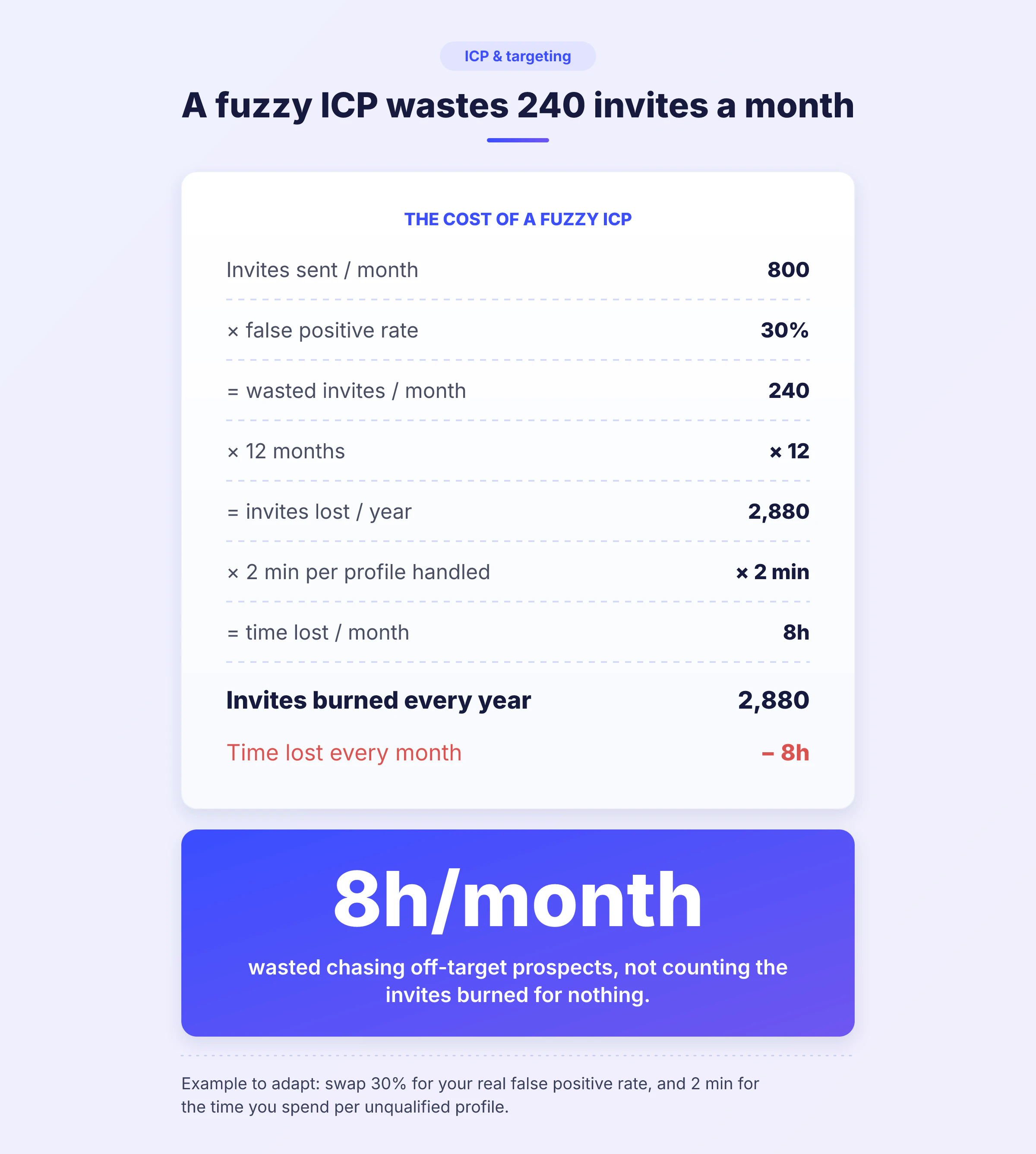
Without a clear ICP, part of your list is off target from day one. On prospect lists built by hand, Waalaxy sees around 30% false positives. That's as many messages sent to people who were never going to buy.
Ideal customer profile vs buyer persona
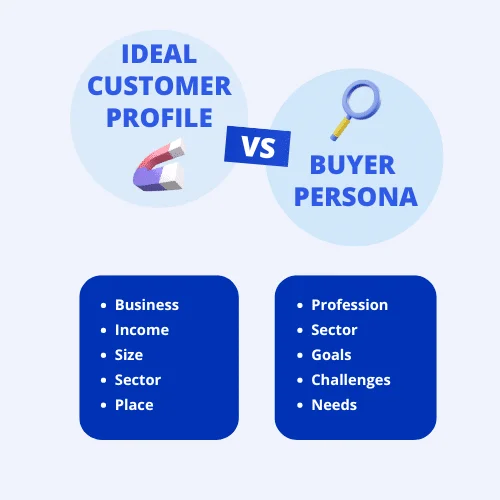
The ideal customer profile and the buyer persona often get mixed up, yet they answer two different questions. The ICP answers "Which company should I target?". The persona answers "Who should I talk to in that company, and how?".
Ideal customer profile | Buyer persona | |
|---|---|---|
What it describes | A company or an account | A (semi-fictional) person |
Criteria | Industry, size, revenue, location, tools | Job title, goals, frustrations, motivations |
Question it answers | Which accounts to target? | How to talk to them? |
Mostly used in | B2B and B2C | |
Example | SaaS SMBs with 50 to 200 employees in France | Marion, HR Director, swamped with hiring |
The two work together. Your ICP tells you where to look, and the persona tells you what to write. A good prospecting campaign always starts from the ICP, then adapts the message to each persona on the buying committee. ✨

Your prospecting agent at half price, for life
€100€50/month, annual plan
Nov 27 12am to Nov 28 noon CET
Discover Waalaxy AI →14-day free trial
The criteria of a good B2B ICP in sales
A useful ideal customer profile fits in 5 to 10 criteria. Fewer, and it's too vague to sort a list. More, and it gets so narrow you can't find anyone. The criteria fall into three families.
Firmographic criteria
This is the firmographic data, the company's ID card: industry, headcount, revenue, region, age, structure (startup, SMB, group). These are the easiest criteria to find, and the ones LinkedIn lets you filter on directly.
Technographic criteria
They describe the tools already in use at the company: CRM, payroll software, email tool, tech stack. They're gold when your offer plugs into a specific tool, or when it replaces a competitor. An agency selling HubSpot consulting has every reason to target companies already on HubSpot.
Behavioral signals
This is the most underrated family. Buying signals show a company is probably looking for a solution: a funding round, a hiring wave, a new executive, an international expansion. On LinkedIn, these signals are easy to spot: a recent job change, a job post, fast headcount growth. A prospect who matches your ICP and just went through one of these events becomes a warm prospect, to contact first. 🔥
Define your ICP in sales in 6 steps
Now you know what goes into an ideal customer profile, so let's get to the method. These six steps take you from a gut feeling ("we mostly sell to SMBs") to a precise profile you'll turn into a prospect list.
1) Think about your product strategy
It all starts with the value you bring. Before looking at your customers, clarify your sales strategy by asking yourself three questions:
What are the main benefits of your offer?
What exact problem does your product solve?
Who on the market needs this solution most?
The answers already tell you whether your offer speaks more to small, mid-sized or large companies, and in which industries the problem hurts most.
2) Start from your 10 best customers
Your best source of information is your current customers. List the ten who get the most value from your offer: satisfied, loyal, profitable and easy to serve. You'll use this work later to build a consistent prospect list. If you're just starting out and don't have ten customers yet, take the ones you have and add the companies that gave you the best feedback in meetings.
Then look at what they have in common: size, industry, budget, buying process. The traits shared by at least seven customers out of ten are the first criteria of your ICP. Also note the customers you'd rather not have again. They help you define what your ICP excludes.
3) Collect the data
You need two types of data. Quantitative data (size, revenue, industry, headcount, technologies) lives in your CRM, in surveys or in public databases.
Qualitative data matters just as much, because it explains why your customers buy. To get it, talk to your customers and your sales reps:
What was their main challenge before working with you?
How do they use your product day to day?
What made them choose your offer over another?
Combining the two gives you a full picture of your best customers, numbers and motivations included.
4) Segment your market
Once you have the data, split your market into segments. Firmographic segmentation is the most obvious, but two other approaches refine your ICP in sales. Psychographic segmentation looks at the company's values and priorities. A company focused on innovation won't react to your offer the same way as one that values stability.
Behavioral segmentation looks at how customers interact with your product. Some buy regularly, others only around a key moment. Understanding these differences helps you adapt your pitch and offer the right deal to each segment.
5) Get your teams working together
The more your teams work hand in hand, the sharper your ICP. 🫱🏽🫲🏼 Marketing attracts and qualifies leads, sales closes the deals, and each side sees part of the picture. Marketing shares engagement trends, the channels that perform and campaign results. Sales reps know the common objections, the length of buying cycles and the decision-making process at customer companies.
6) Build a detailed profile and validate it
Last step: pull everything into a one-page profile. It should include firmographic data, needs and motivations, the buying process (who decides, who influences) and the technologies in use. Here's an example for an IT services company.
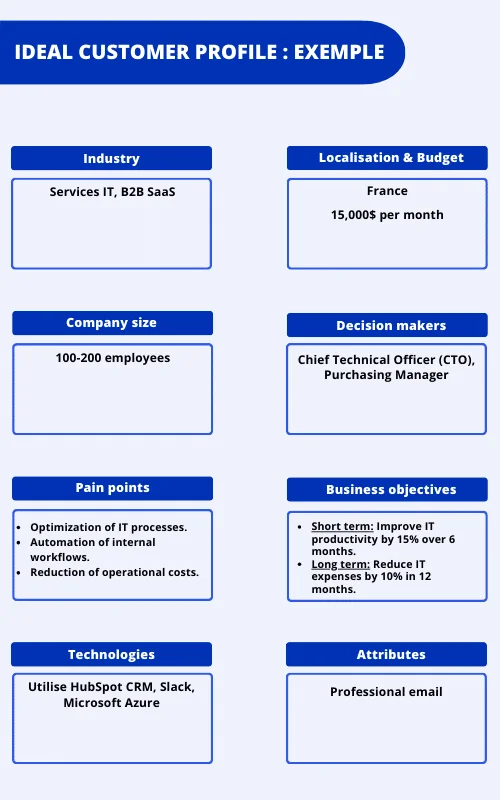
An ICP is never set in stone. Test it on a first campaign, compare reply rates across segments, then update it every 6 to 12 months, or as soon as your offer or your market changes.
B2B ICP examples, template and scoring
Theory is nice. Concrete examples are better. Here are three B2B ideal customer profiles, each with its main persona and the matching LinkedIn search.
Business | ICP | Main persona | LinkedIn search |
|---|---|---|---|
HR SaaS vendor | SMBs with 50 to 250 employees, growing, France | HR Director or HR Manager | HR function, headcount 51-200 and 201-500, positive headcount growth |
B2B marketing agency | Tech companies with 20 to 100 employees, no structured marketing team | Founder or CEO | Founder seniority level, software industry, headcount 11-50 and 51-200 |
Tech recruitment firm | Scale-ups hiring developers | CTO or Head of Engineering | CTO job title, companies posting job offers |
Notice the "LinkedIn search" column only uses filterable criteria. That's on purpose. An ICP in sales that doesn't translate into a search stays a strategy document, not a prospecting tool. 😉
ICP template to copy
To formalize your own ICP, fill in this template. It fits on one page, and it's all your team needs.
Section | To fill in |
|---|---|
Industry | E.g. B2B software, business services |
Size | Headcount, revenue |
Region | Countries, regions, language |
Tools in use | CRM, stack, current competitor |
Main problem | What's blocking them before working with you |
Buying triggers | Funding round, hiring, new executive |
Decision-maker and influencers | Who signs, who recommends |
Exclusion criteria | Who you don't want as a customer |
Want to go faster? Waalaxy's free ICP generator helps you set up a first version in a few clicks. Then you just fine-tune it with your own data.

ICP Generator
Describe your product, the problem it solves and your industry: AI suggests your 3 ideal customer profiles, with the decision-maker to reach on LinkedIn.
Score your prospects against your ICP
Not every prospect who matches your ICP is worth the same, and knowing how to qualify a prospect is still a must. To prioritize, give each criterion a weight and add up the points. For example: target industry (30 points), right company size (25 points), decision-maker identified (20 points), recent buying signal (25 points). Above 75 points, the account goes into tier A, to contact first. Between 50 and 75, tier B. Below that, tier C, to keep for later. This simple scoring is enough to organize your week, and it follows the same logic as solid account-based prospecting. 📊
Find and contact your ideal customer profile on LinkedIn
Defining your ICP is great, but now it's time to act. LinkedIn is the perfect place for it. Companies and decision-makers describe their own job, industry and team size there. All that's left is to turn each criterion into a filter.
Turn your ICP into Sales Navigator filters
Sales Navigator offers filters that match the criteria of an ICP for sales almost one to one. Here's how they line up.
ICP criterion | Sales Navigator filter |
|---|---|
Industry | Industry |
Company size | Company headcount |
Region | Geography (prospect's location or HQ) |
Decision-maker | Function, seniority level, job title |
Revenue | Annual revenue (account search) |
Growing company | Company headcount growth |
Buying signal | Changed jobs recently, posted on LinkedIn recently |
Without Sales Navigator, the classic search works too, just with less precision. Combine keywords with LinkedIn search and its Boolean operators to keep your list clean.
Contact your ICP with Waalaxy
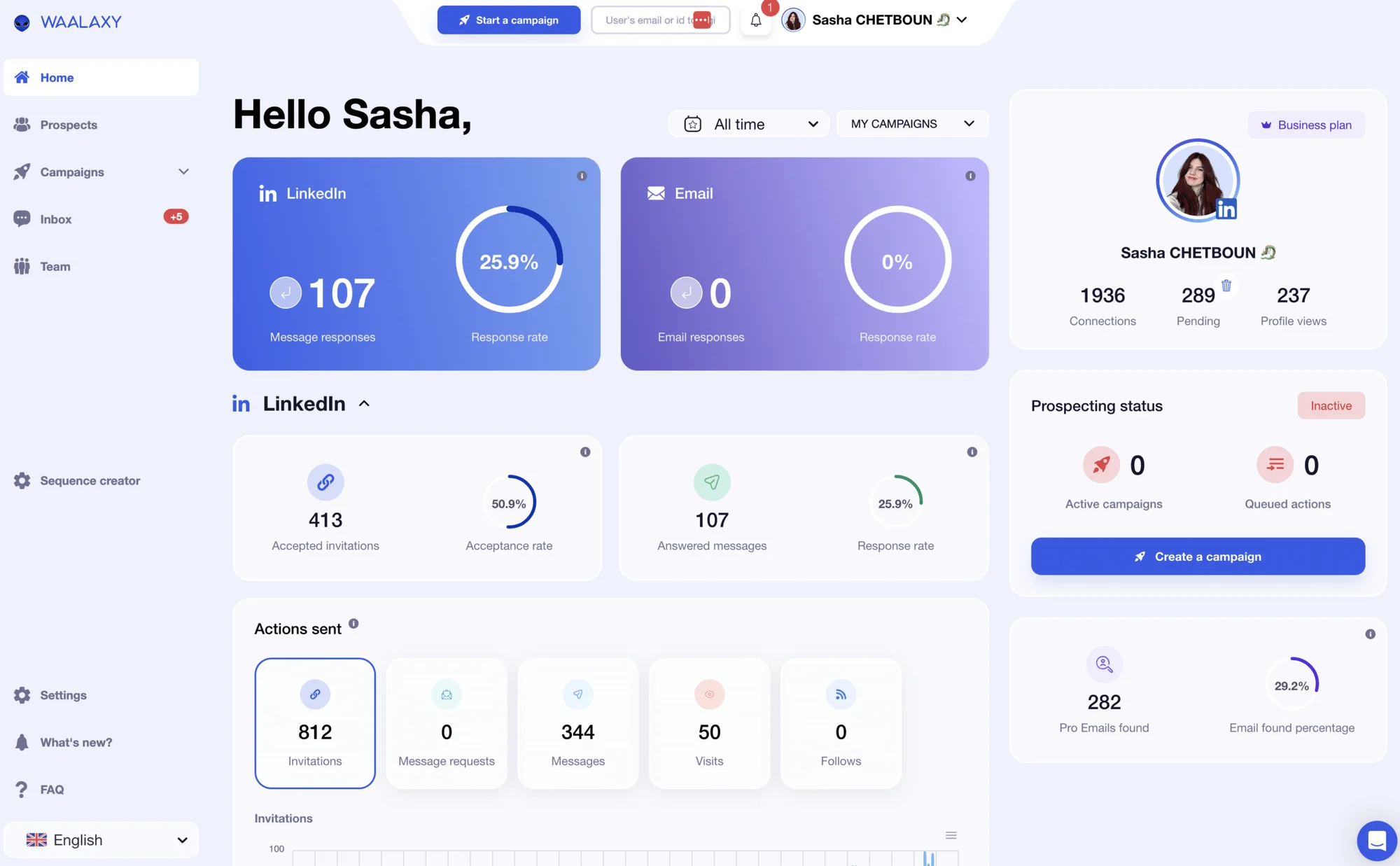
Once your list is ready, you still need to contact these prospects without spending your days on it. Waalaxy automates your prospecting on LinkedIn and by email. You import your prospects from a search, pick a message sequence from dozens of templates, and the tool handles invitations, messages and follow-ups at the right pace.
Import prospects from LinkedIn and Sales Navigator.
Multichannel LinkedIn and email sequences.
Automatic follow-ups that stop as soon as the prospect replies.
Message personalization with variables and an AI assistant.
Performance tracking and CRM integration.
With a solid ICP in sales as your starting point, these sequences bring back replies from people who are actually able to buy. That's the whole difference with mass sending. To go further, see how to find prospects on LinkedIn beyond Sales Navigator.
How AI helps you define and find your ideal customer profile
Defining an ideal customer profile, then turning it into filters, takes time and some experience. That's exactly where artificial intelligence changes the game. It analyzes your offer, suggests targets, looks for matching profiles and filters out the ones that don't fit, in a few minutes instead of several days. It doesn't replace your field knowledge, but it automates the tedious part of the work. 🤖
What AI does at each step of your ICP in sales
Let's go back to the 6-step method from earlier. For each step, here's what an AI prospecting agent takes over, and what stays in your hands.
Step | What AI does | What you keep |
|---|---|---|
Product strategy | Reads your website and sums up your offer, use cases and promise | Check the summary is accurate |
Best customers | Spots what your reference profiles have in common | Pick the reference customers |
Data collection | Analyzes LinkedIn profiles: job title, company, size, industry | Bring the qualitative side (customer interviews) |
Segmentation | Suggests several distinct targets, including a recommended one | Choose the target to test |
Prospect search | Looks for profiles matching the target | Set the exclusions (customers, partners) |
Qualification | Filters out off-target profiles before any contact | Adjust the target based on results |
This table shows one thing. AI is great at volume and repetition (reading hundreds of profiles, applying criteria without getting tired), and you're great at judgment and context.
From your website to your first targets
This is the step Waalaxy AI, Waalaxy's LinkedIn prospecting agent, makes the simplest. You give it your website URL, it analyzes your offer and suggests 2 to 4 targets, including a recommended one. Each target is a first draft of your ICP in sales: a type of company, a decision-maker, and the reason your offer speaks to them. You pick one, then the agent finds the prospects itself (you don't need Sales Navigator, but it uses it if your account has it).
Filter out false positives and qualify the target
On a list built by hand, around 30% of profiles don't really match the target. The agent analyzes each profile before contacting it and filters out the ones that don't fit your ideal customer profile: wrong job title, company too small, unrelated industry. During the conversation, it keeps qualifying prospects. It asks simple questions about need, timing or team, and hands over to you when the prospect is ready. To see everything an AI agent does beyond targeting, we've written a full guide on it. 🎯
What AI doesn't replace
AI suggests, you decide. It doesn't know your margins, the customers who wasted your time or the markets you want to open next year. It also works from what's visible on LinkedIn. A criterion like budget or team maturity stays hard to guess from a profile. So keep your ICP method as your reference, and use AI to test it faster and on more prospects.
ICP in sales: the key takeaways
Building an ideal customer profile is much more than a segmentation exercise. It steers all your sales efforts toward the customers who'll bring you the most value. Start from your best customers, keep 5 to 10 firmographic, technographic and behavioral criteria, then turn them into LinkedIn filters. Score your prospects to know who to start with, and update your ICP regularly. The hard part isn't defining your ICP in sales. It's using it every day. Launch your next campaign from your ideal customer profile and compare the results.
FAQ: ICP in sales
An ideal customer profile should hold enough information to decide, in a few seconds, whether an account is worth contacting. The essentials:
Firmographic data: size, industry, revenue, location.
The needs and pain points your offer solves.
Buying behavior: who decides, how fast, on what criteria.
The tools already in place and any competitors.
The expected long-term customer value.
Exclusion criteria, just as important as inclusion criteria.
Aim for 5 to 10 criteria. Under five, your ICP is too broad to sort a prospect list, because everyone fits. Over ten, it gets so specific you can't find enough companies to contact. Start with firmographic criteria, add one or two technographic criteria if your offer depends on them, then a buying signal to prioritize.
Yes, and it's common as soon as a company sells to several types of customers. A software vendor might have an "SMB" ICP and an "enterprise" ICP, with very different sales cycles and messages. The rule: one ICP per segment that buys for different reasons. Beyond three, you spread yourself thin, so prioritize the one that brings in the most.
Review your ideal customer profile every 6 to 12 months, and sooner if your offer, your prices or your market change. The warning signs:
Your reply rate drops on a segment that used to work well.
Your new customers no longer look like your ICP.
Your sales reps spend time on prospects who never buy.
Test it in the field. Run a campaign on about a hundred prospects who match your ICP, and another on a similar segment. Compare the acceptance rate, the reply rate and the number of meetings. If your ICP doesn't beat the control segment, your criteria are off. Sales performance indicators help you track these results over time.
A marketing target is often broad, like "French SMBs". An ICP is much more precise. It describes the subset of that target most likely to buy, stay a customer and recommend you. Put simply, your target tells you where you're able to sell, and your ICP tells you where you should sell first.
It gives you a very good first version. By analyzing your website, your offer and LinkedIn profiles, an AI agent identifies consistent targets and explains why they need you. But it doesn't see what isn't online: your margins, your best customers, the segments that waste your time. The most effective approach:
let AI suggest 2 to 4 targets.
check them against your 10 best customers.
keep the one that ticks the most criteria, then test it on a first campaign.
In two stages. Before contact, it compares each profile with the target criteria (job title, industry, company size, location) and filters out the ones that don't match. During the conversation, it asks simple qualifying questions to check need and timing, then hands over to you when the prospect is ready to talk. This upfront sorting is what avoids the false positives of handmade lists.