
A prospecting strategy is what separates a calendar full of meetings from a month spent sending invitations nobody answers. 😅 The problem is rarely effort. It's the lack of a framework, when nobody has decided who to contact, on which channel, with what message or how often. In this guide, you'll get a 7-step method to build your B2B prospecting strategy, a ready-to-adapt 3-week action plan, and the levers that fill your pipeline.
What is a sales prospecting strategy?
A sales prospecting strategy is the framework behind every action you take to find new clients. It answers five questions. Who do you target, on which channel, with what message, how often, and how do you measure results? Where sales prospecting is the act of looking for clients, the strategy sets the direction before you make a move.
In B2B, that framework matters even more. Sales cycles are longer, and a buying decision often involves several decision-makers (the user, their manager, sometimes finance). If you're just starting out, the basics of B2B prospecting give you the context. Here, we focus on the method.
The key points
If you only have two minutes, keep these four points in mind.
A prospecting strategy answers five questions: who, on which channel, with what message, how often, and with which tracking metrics.
The method fits in 7 steps: goals, target, prospect list, channels, messages, schedule and measurement.
The average reply rate of Waalaxy campaigns is 16.6%, and the best strategies reach 47.8%.
Automation saves you time, but you stay in charge of replies and meetings.
Strategy, plan, campaign, technique: what's the difference?
These four words get mixed up all the time, even in Google results. They don't sit at the same level, though. The table below puts them back in order, from the broadest to the most concrete.
Level | Question it answers | Time frame | Example |
|---|---|---|---|
Strategy | Who to target, why and on which channels? | 6 to 12 months | Go after marketing directors at SMBs through LinkedIn and email. |
Action plan | What to do, when and with which resources? | One quarter | 150 prospects contacted per month, two call slots per week. |
Campaign | Which sequence for which segment? | 2 to 6 weeks | Invitation, two messages, then a follow-up email. |
Technique | How do you do it in practice? | One-off | Social selling, a call after a message, a follow-up. |
This guide covers the first level. The methods themselves are broken down one by one in this list of prospecting techniques to test depending on your target.
Why write down your prospecting strategy in 2026
B2B buyers do their own research before they talk to a sales rep. They compare options, read reviews and check out your profile. Meanwhile, inboxes and LinkedIn messages are overflowing with generic pitches. Without a precise target or a personalized message, you get lost in the noise. A written prospecting strategy forces you to make those choices before the first send, so you stop improvising.

Your prospecting agent at half price, for life
€100€50/month, annual plan
Nov 27 12am to Nov 28 noon CET
Discover Waalaxy AI →14-day free trial
How to build a B2B prospecting strategy in 7 steps
Here's the method, step by step. Each step has a goal, concrete actions and one mistake to avoid. You can follow it alone or as a team, with or without a tool. 🛠️
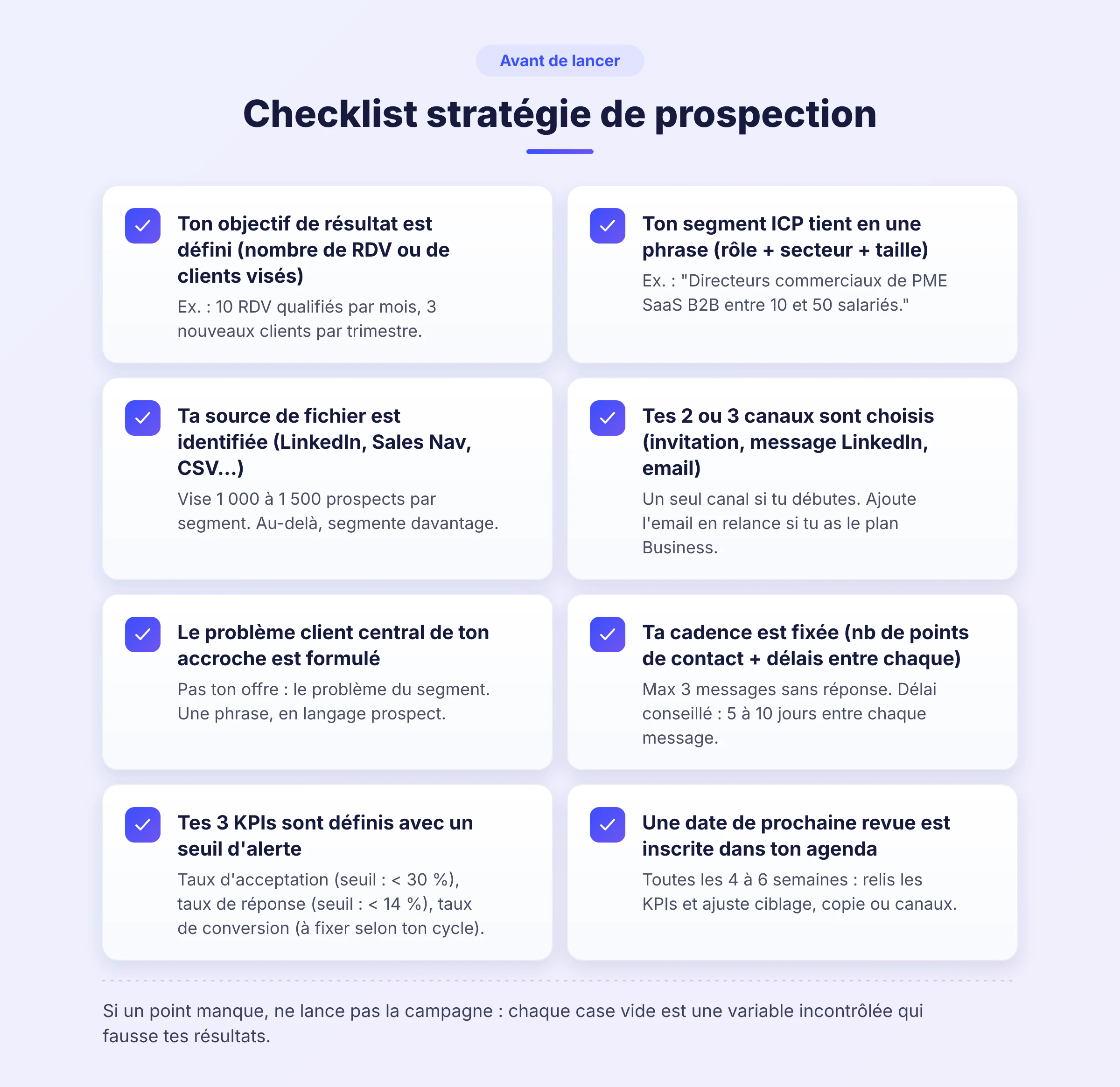
1. Set numbers-based goals
Start from the result you want, then work your way back up the funnel. How many clients do you want to sign this quarter? How many meetings does that take? How many replies do you need to get those meetings? This reverse calculation gives you the number of prospects to contact. It turns a vague wish into a measurable goal.
Ratios vary from one industry to another. To set yours, rely on your prospecting funnel and correct it every month. The common mistake is setting a volume goal ("500 invitations") instead of an outcome goal ("16 meetings").
2. Define your ideal customer profile (ICP) and personas
A good prospecting strategy starts with a narrow target. First, define your ideal customer profile at company level: industry, size, location and growth signals. Then describe the buyer persona, with their role, their challenges and what's holding them back today. Here's an example for a marketing agency:
Criterion | Example |
|---|---|
Industry | B2B software and service companies. |
Size | 20 to 200 employees. |
Location | United States. |
Decision-maker | Marketing director or head of acquisition. |
Challenge | Get more inbound requests without growing the team. |
Buying signal | Hiring in marketing, posting about acquisition, visited your profile. |
Waalaxy assumes you know who your buyer is. If that's not the case yet, take the time to write it down, for example with the generator below. The classic mistake? Targeting "all SMBs", which forces you to write a message that speaks to nobody.

ICP Generator
Describe your product, the problem it solves and your industry: AI suggests your 3 ideal customer profiles, with the decision-maker to reach on LinkedIn.
3. Build and qualify your prospect list
Once your target is set, you need names. Three sources work well in B2B. LinkedIn Sales Navigator first, to filter by job title, industry and company size. Next, intent signals: people who visited your profile, commented on a post or sent you an invitation. Finally, email enrichment to reach your prospects outside LinkedIn.
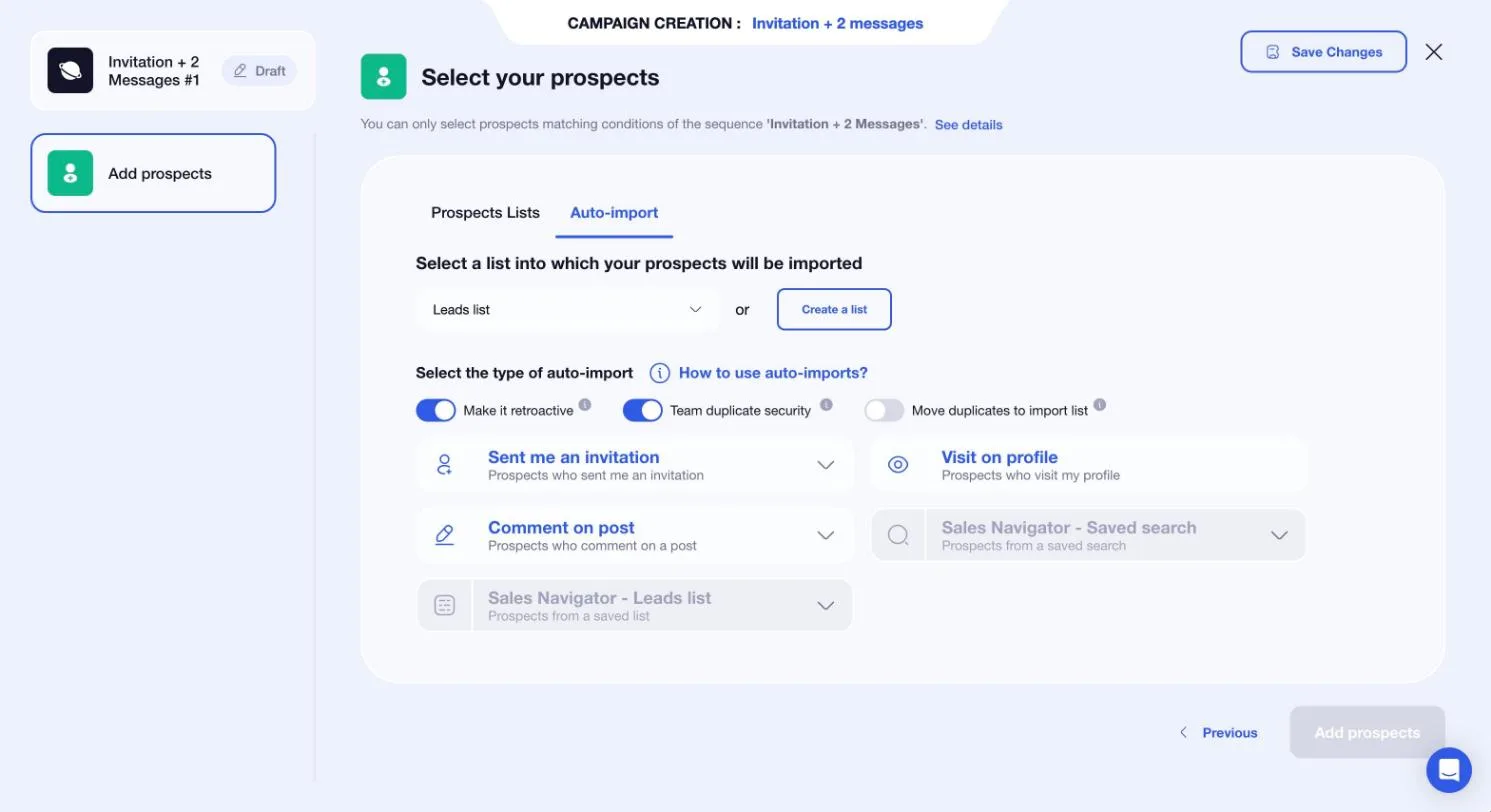
With Waalaxy's auto-import, these signals feed straight into a campaign: profile visitors, people who comment on a post, saved Sales Navigator searches. For addresses, the Email Finder looks for the work email from the LinkedIn profile, and Waalaxy doesn't store any contact database.
To structure this work, the steps of a prospecting file help you sort your contacts and keep a clean database. If you're starting from scratch, a prospecting database is easy to build with a bit of method from day one.
4. Choose your prospecting channels
You don't need to be everywhere. Pick two or three prospecting channels where your target spends time, based on your budget and your timeline. The table below compares the most common options.
Channel | Best for | Cost | Time required | Time to results |
|---|---|---|---|---|
B2B decision-makers active on the network. | Low to medium. | Medium, less with automation. | A few weeks. | |
Targets who aren't very active on LinkedIn. | Low. | Medium. | A few weeks. | |
Phone | Reachable decision-makers, complex offers. | Medium. | High. | Fast. |
Content and SEO | Buyers who do their own research. | Medium. | High. | Several months. |
Webinars | Prospects already aware of the topic. | Medium. | High. | 1 to 2 months. |
Field sales and trade shows | Local or very relationship-driven industries. | High. | High. | Varies. |
In practice, the LinkedIn, email and phone trio covers most B2B cases. It's the core of multichannel digital prospecting. The phone still has its place for high-value offers, and a call works much better after a first touch on LinkedIn.
5. Write a value proposition and personalized messages
Your message should be about the prospect, not about you. A simple structure works well: a concrete problem your target faces, short proof (a client result, a use case), then an open question. The AIDA framework (attention, interest, desire, action) follows the same logic in a longer format.
For the first draft, Waami, the AI message generator built into Waalaxy, gives you a base that you then adjust to your style. The best practices for LinkedIn prospecting messages and these cold email templates help you vary your hooks. The common mistake is still the message that could be sent to anyone.

LinkedIn prospecting message generator
Describe what you sell and to whom: the tool writes your first message, focused on your target’s problem.
6. Plan a multichannel sequence
One message is almost never enough. Plan 4 to 6 touchpoints over two to three weeks, a few days apart. The most natural order in B2B starts on LinkedIn (profile visit, invitation, message), continues by email for those who didn't accept, and ends with a call for the warmest prospects.
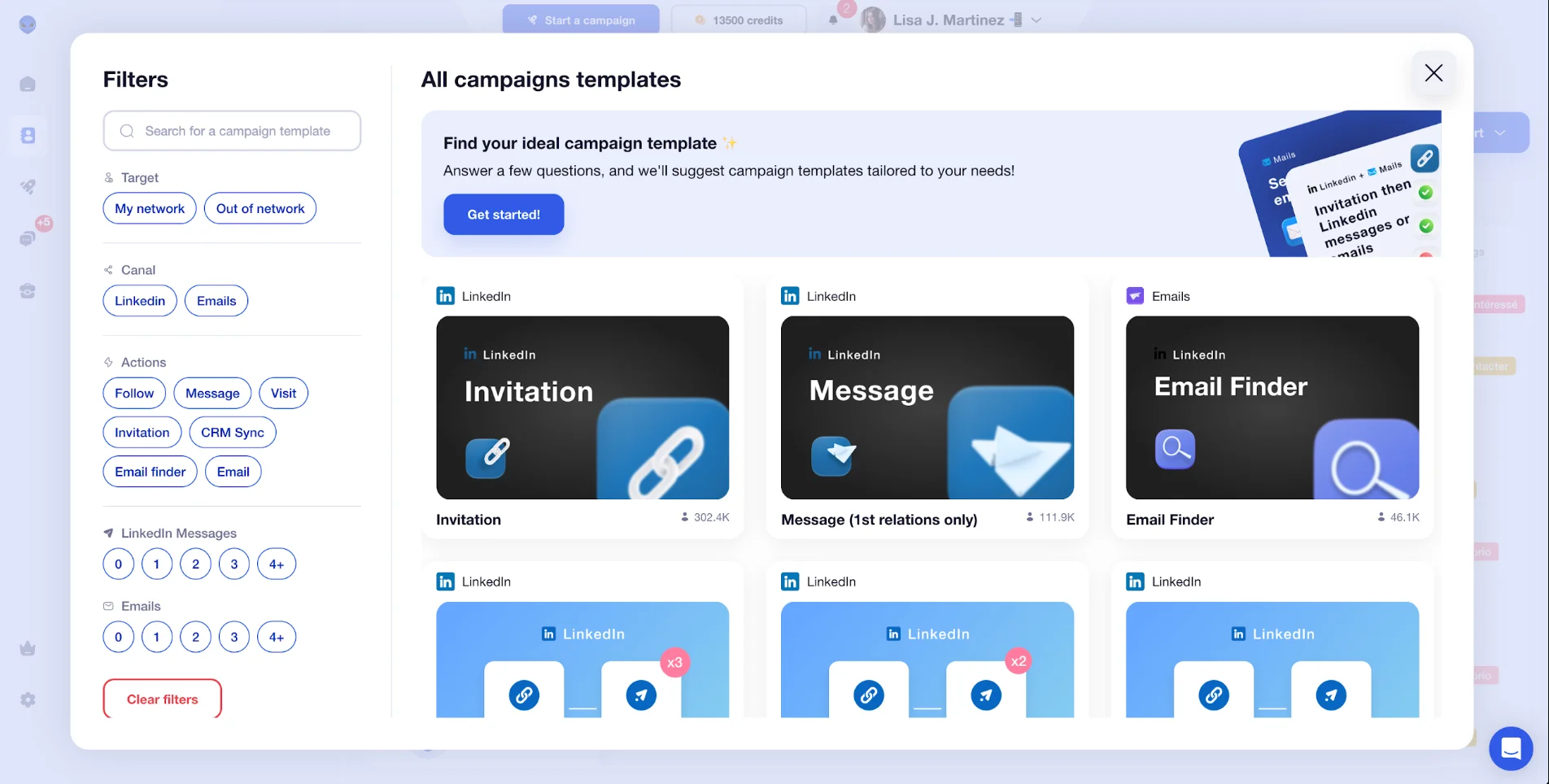
On Waalaxy, you pick a sequence from a catalog of ready-made templates, for example "Invitation + 2 Messages". Multichannel templates chain an invitation, LinkedIn messages and then a follow-up email to people who haven't replied. Everything runs in the cloud, even with your computer off. To go from schedule to execution, each step of a prospecting campaign is laid out step by step.
As for timing, leave two to four days between two messages. The concrete delays for each LinkedIn follow-up message keep you from coming across as pushy.
7. Measure, test and adjust
A prospecting strategy lives and changes with your results. Track the same metrics every week:
The acceptance rate of your LinkedIn invitations.
The reply rate to your messages and emails.
The number of meetings booked.
The conversion rate from meetings to clients.
The customer acquisition cost (time spent, licenses, data).
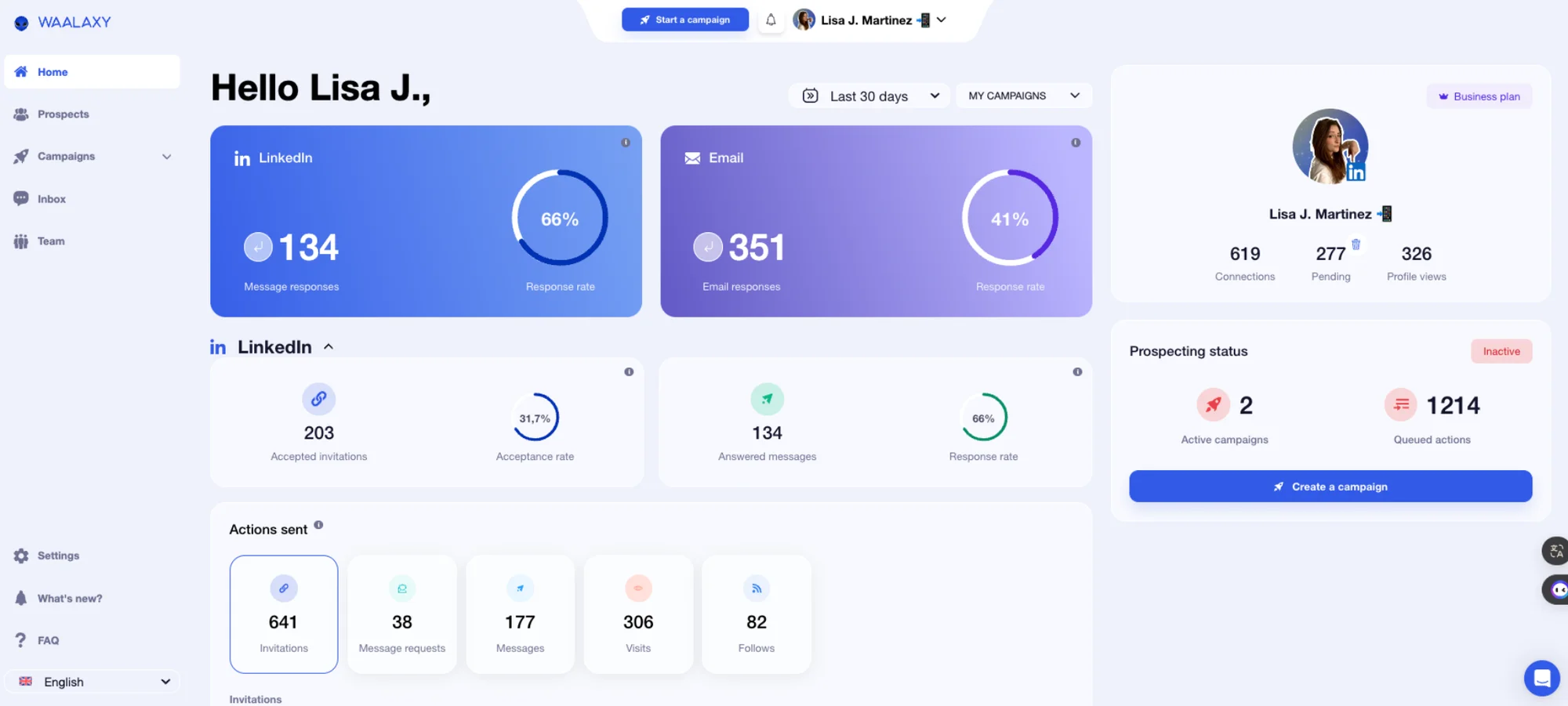
For reference, the average reply rate of Waalaxy campaigns is 16.6%. The best strategies climb to 47.8%. The gap almost always comes down to the target and the message. To improve, run A/B tests by changing one element at a time (the hook, the length, the call to action) and compare on a large enough volume. The breakdown of LinkedIn KPIs helps you read each number. 📊
Prospecting strategy example: a 3-week action plan
Here's a fictional case to see the method in action. Lina runs an 8-person marketing agency. She wants to sign new clients among marketing directors at B2B SMBs, without hiring a sales rep. 🎯 She sets the framework first:
Target: marketing directors at B2B SMBs with 20 to 200 employees, in the United States.
Goal: 8 meetings in 3 weeks.
Channels: LinkedIn first, email for follow-ups, phone for warm prospects.
Volume: 150 prospects pulled from a Sales Navigator search, checked by hand.
Her schedule follows the same rhythm for each prospect. Week 1 is for the first contact, week 2 for follow-ups, week 3 for the call and the review.
Day | Channel | Action | Goal |
|---|---|---|---|
D1 | Profile visit. | Show up in their notifications. | |
D2 | Invitation with no note. | Get into their network without a pitch. | |
D4 | Message after acceptance. | Open the conversation on a concrete problem. | |
D8 | Short follow-up. | Share a useful resource (case study, article). | |
D10 | Email to prospects who didn't accept. | Reach people who aren't very active on LinkedIn. | |
D15 | Phone or LinkedIn | Call or last message. | Offer a time slot or close the loop politely. |
D21 | Review | KPI analysis. | Keep what works, change one element only. |
At the end of week three, Lina compares her numbers with her goal. If the acceptance rate is low, she reworks her profile or her target. If prospects accept but don't reply, she changes the hook of her first message. Days 1 to 10 can be automated with a Waalaxy campaign, which frees up time for replies and calls. You can test this plan with the 14-day free trial, no credit card required.
The levers to pull in your prospecting strategy
The method sets the framework, the levers make it run. You don't need to pull all of them. Pick the ones that fit your target and the time you have.
A LinkedIn profile that builds trust
Before replying, most prospects look at your profile. If it doesn't clearly say what you do and who you help, you lose points from the invitation onward. Check these elements:
A headline that explains your value for your target.
Concrete results in your summary and experience.
Social proof such as recommendations, client cases or posts.
A professional photo and a clean banner.
Your expertise visible in your latest posts.
Every section counts, and this method to make a good LinkedIn profile goes through them one by one.
Social selling
Social selling means building the relationship before you sell. Follow your prospects' posts, comment with a real point of view and share useful content. When the invitation lands, your name already rings a bell. You get more human conversations and more replies. 🤝
Email sequences and follow-ups
Email still works if it's short, relevant and useful. Plan two or three follow-ups a few days apart, each with a different angle. In the UK, the ICO rules on B2B marketing emails let you email employees at companies without prior consent, as long as you say who you are and give them a simple way to opt out. Sole traders and some partnerships are treated like individuals and need consent, and the rules differ in other countries, so check them for each market you target.
Phone prospecting
The phone hasn't gone anywhere. It works best as a complement, because a call after a LinkedIn message or an opened email goes over much better than a cold call. Save it for prospects who have shown a sign of interest. Prepare two or three questions rather than reading a script.
Content, case studies and webinars
Outbound prospecting works better when your target already knows you. Articles, guides, LinkedIn posts and case studies show what you can do. Webinars attract prospects already interested in the topic, whom you can then contact with a tailored message. Client testimonials serve as proof at every stage.
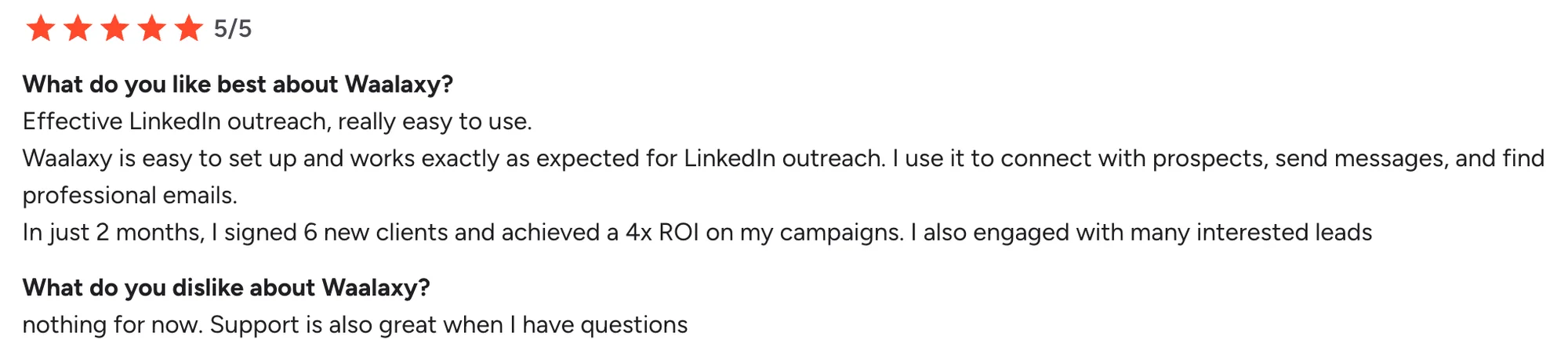
An effective case study shows three things: the starting situation, the method used and the result. You can slip it in as a link in your day-8 follow-up. ✨
Automation without losing the human touch
Automating a bad approach will never give you good results. Once your target and message are validated, though, automation gives you back hours every week. Hand off repetitive tasks like profile visits, invitations, follow-ups and email searches. Keep for yourself what builds the relationship: replying, qualifying and booking meetings.
Waalaxy runs in the cloud, so your campaigns keep moving even with your computer off. The Inbox gathers your LinkedIn replies in one place so you never miss a conversation. And 75% of Waalaxy clients had never done automated prospecting before using it.
Hand the execution to an AI prospecting agent
Building a prospecting strategy takes a skill many people have never learned. If that's you, or if you're short on time, Waalaxy AI can take over. It's an autonomous LinkedIn prospecting agent, a product separate from Waalaxy, with its own app and its own subscription.
You give it your website URL and it suggests 2 to 4 targets. From there, the work follows four steps:
The agent finds prospects and filters out those who don't match your target.
It writes the messages, one by one, based on each prospect's profile.
It runs the conversation to move toward your goal.
You close the deal, and you take back control whenever you want.
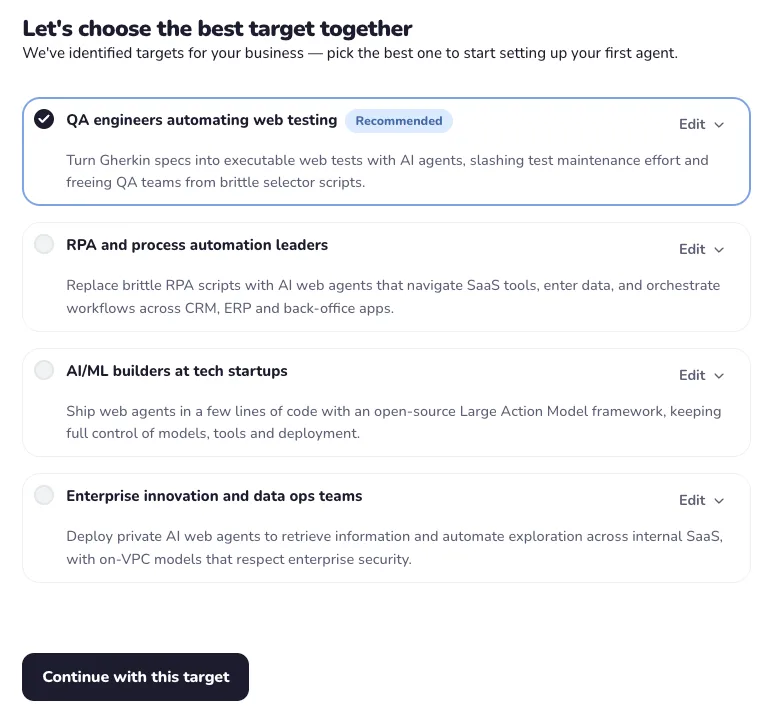
You choose its level of autonomy: Assisted, where you approve each message before it goes out, Semi-autonomous, where the agent sends sequences on its own and you approve its replies, or Autonomous, where it sends and replies on its own and only asks you when it needs context. Waalaxy AI costs $100 per LinkedIn account per month, with a 14-day free trial, with or without a credit card. This comparison of AI prospecting tools shows how it stacks up against other agents.
What budget and which tools for your prospecting strategy?
The budget for a prospecting strategy depends on three items: the sales time spent prospecting, tool licenses and data access (subscriptions, enrichment credits). Time is often the heaviest item, which is why it pays to equip the repetitive steps. Here's a simple stack, step by step.
Step | Tool | Role |
|---|---|---|
Targeting | LinkedIn Sales Navigator | Filter the accounts and decision-makers that match your ICP. |
LinkedIn and email execution | Waalaxy | Launch sequences of invitations, messages and follow-up emails. |
Enrichment | Waalaxy Email Finder | Find the work email from a LinkedIn profile (1 credit per email found). |
Opportunity tracking | CRM (HubSpot, Pipedrive) | Track meetings and deals, through Waalaxy's native integration. |
Delegated execution | Waalaxy AI | Hand the target, the messages and the conversation to an agent. |
To compare your options, this selection of sales prospecting tools covers the main categories. As the team grows, a Sales Ops role takes over to organize tools, data and processes, often backed by dedicated sales ops software. 💡 Start small, because an execution tool and a CRM are often enough to validate your strategy before you invest more.
Common prospecting strategy mistakes
Most strategies that fail trip over the same points. Good news: each one has a simple fix.
Mistake | Fix |
|---|---|
Targeting too broadly. | Narrow your ICP to one segment, even if you test another one later. |
Favoring volume over quality. | Check a sample of the list before each campaign. |
Sending a generic message. | Start from a specific problem your target has and add a personal detail. |
Not following up. | Plan 2 to 3 follow-ups, with a different angle each time. |
Automating a bad approach. | Test the message by hand on 20 prospects before automating. |
Measuring nothing. | Track 4 or 5 KPIs every week in a single table. |
Relying on a single channel. | Add a second channel to reach people who don't reply. |
If you could fix only one thing, start with the target. A good message sent to the wrong person will get you nowhere, while an average message sent to the right person often gets a reply.
You've got your method, a sample schedule and the traps to avoid. Time for your first campaign. 🚀
Prospecting strategy: key takeaways
An effective prospecting strategy fits in 7 steps. You set numbers-based goals, define your target, build a clean list, choose your channels, write personalized messages, plan a multichannel sequence and measure every week. Everything else is levers you pull depending on your target and your time.
The easiest way to get started? Take Lina's 3-week plan, adapt the target and the message, then launch it with Waalaxy. And if you'd rather delegate the execution, Waalaxy AI handles it while you focus on your meetings.
FAQ: prospecting strategy
Start with a numbers-based goal, then work back up the funnel to find how many prospects you need to contact. Next, define your target and build a qualified list. Pick 2 or 3 channels, write messages centered on the prospect's problem and plan a schedule of 4 to 6 touchpoints. Finally, measure your reply rates every week and adjust one element at a time.
Prospecting is often summed up in four steps, which follow each other in this order:
Identify and qualify the prospects who match your target.
Prepare your approach, with the message, the channel and your talking points.
Reach out and follow up until you get a reply.
Track and convert, from the meeting to the signed deal.
Your prospecting strategy sits above these steps. It decides how you run all four and with which resources. To prioritize your contacts from the first step, lead scoring helps you rank the warmest profiles.
The strategy sets the direction: who to target, on which channels and with which positioning. It changes little, over 6 to 12 months. The action plan turns it into dated tasks, like the number of prospects per week, the sequences to launch or the call slots. Without a strategy, the plan goes in every direction, and without a plan, the strategy stays a good intention.
In B2B, the most effective digital approach combines LinkedIn and email, with content in support. It's the foundation of steady B2B lead generation. Each channel has its role:
LinkedIn to get in touch and build the relationship (visit, invitation, message, follow-up).
Email to follow up with people who didn't accept, with a short, personalized subject line.
Content to make your name familiar and back up your messages.
Automation lets you keep up this pace without spending your days on it.
In a new market, you don't know the right messages yet. Start small, with a precise segment, 50 to 100 prospects and two message variants. Watch the replies, including the no's, because they teach you your target's vocabulary and objections. Once the message is validated, increase the volume and add a channel.
The cost depends mostly on the time you spend, then on tools and data. A freelancer can start with an automation tool and a few hours a week. A team will usually add a CRM, Sales Navigator and enrichment credits. With Waalaxy, the 14-day trial with no credit card lets you test your strategy before investing. Waalaxy AI costs $100 per LinkedIn account per month.